Fitted or modular furniture is a kind of "constructor" for adults. Nowadays, it is an essential section in furniture store catalogs. It is a popular and convenient way to personalize home or office spaces.
As mentioned before, the main advantage is the ability to create furniture based on personal preferences and desires. It is named after the main element - the wooden frame, as well as the surfaces and walls that are attached to neighboring frames.
Among modular furniture, you can find wardrobes, tables, and dressers. Sofas, ottomans, and armchairs belong to the category of soft furniture and are not considered fitted, even if they are assembled from multiple parts. There is also a third classification - lattice furniture. It includes tables, shelves, chairs, and stools made of supporting elements interconnected in a grid-like manner.
Let's consider the positive aspects of fitted furniture. The main one is mobility. Such furniture can be quickly disassembled and reassembled if there is a need to change the arrangement of elements or a desire to replace certain components with others. Fitted furniture is often chosen for children's rooms, living rooms, or kitchens - rooms where the mobility of elements and the ability to quickly change the interior without additional costs are particularly important.
The dimensions of modular furniture depend on the material and the number of elements. However, in any case, this type of furniture does not significantly differ from any other in terms of weight or size. Manufacturers usually provide all the necessary information in the description, including the weight of each element and the estimated assembly time.
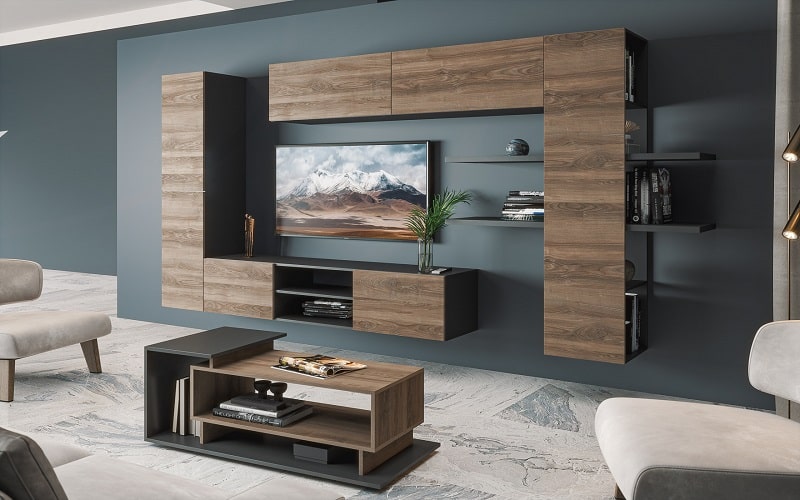
Solid Wood, Particleboard, or MDF - What the Difference Actually Means
The core material inside cabinet furniture affects far more than price. Solid wood is the most durable and ages the most gracefully, but it moves with humidity and temperature, which matters for tight-tolerance modular systems. Particleboard (chipboard) is the most common budget option - stable and affordable, but genuinely vulnerable to moisture at cut edges and screw points if the edge banding isn't done well. MDF sits between the two: denser and more stable than particleboard, machines cleanly for painted or profiled fronts, but heavier and, like particleboard, sensitive to prolonged water exposure.
Why Hinges and Runners Deserve as Much Attention as the Cabinet Itself
The hardware inside a cabinet - hinges, drawer runners, soft-close mechanisms - determines how the piece actually feels to use every day, far more than the visible panel material does. A cabinet built from excellent material with poor hardware will feel loose and unreliable within a year or two; a more modest cabinet with quality hardware from specialists like Blum or Hettich will still open and close precisely a decade later. When budget is limited, it's almost always better to economize on the visible finish before economizing on the mechanism.
Built-In or Freestanding
Cabinet furniture comes in two kinds. Freestanding (modular) wardrobes, dressers, and shelving can be rearranged or taken with you when you move. Built-ins are made to fit a specific niche from floor to ceiling: they use every inch, hide uneven walls, and read as part of the architecture. For entries, closets, kitchens, and window niches, built-ins almost always pay off. For kids' rooms and spaces that change often, modular systems are more practical. We cover closet planning in our article on wardrobe systems.
How to Plan Cabinetry in a Project
- Start with what you store, not with the fronts. List what each cabinet needs to hold: clothes, shoes, dishes, a vacuum, seasonal gear. That decides cabinet depth, shelf heights, and how many drawers you need.
- Measure after rough work. Final dimensions are taken once walls and floors are finished to their final plane; otherwise the cabinet will not fit the niche.
- Plan light and power. Interior lighting, a charging outlet in the entry closet, or power for appliances in a kitchen cabinet have to be roughed in before finishes.
- Match the fronts to the interior. Using the same fronts for the kitchen, closets, and flush doors turns furniture into architecture, as in our article 8 interesting design solutions.
Custom Cabinetry in the Seattle Area
Around Seattle you can choose between local custom cabinet shops, semi-custom lines, and imported European systems. When comparing quotes, look past the price at the core material, edge banding, hardware brand, finish, and whether installation is included. In older Seattle homes, walls are rarely perfectly straight, so scribe strips and fillers should be part of the design. Our wet winters also mean a well-planned mudroom with ventilated storage for coats and boots is one of the most useful built-ins you can add. We help with furniture selection and storage planning in every room, including the kitchen, entry, and bedroom. If you prefer Italian makers, see our article on Molteni&C furniture.
Frequently Asked Questions
Is solid wood always worth the extra cost over MDF or particleboard? Not automatically - it depends on the piece and its exposure to humidity and temperature swings. For a stable, climate-controlled interior, the practical performance difference is smaller than the price difference might suggest.
Can damaged edge banding on particleboard furniture be repaired? Often yes, if caught early - a lifted edge can usually be re-glued or replaced before moisture reaches the core material, but once swelling has occurred, the damaged section typically needs replacing.
How can I tell if cabinet hardware is genuinely good quality before buying? Open and close several drawers and doors in the showroom - quality soft-close mechanisms feel smooth and controlled the entire way, with no sudden drop or clunk near the end of travel.


