
Architectural minimalism took shape in the mid-20th century. Its best-known motto is Ludwig Mies van der Rohe's "less is more": the phrase itself is older - it appears in a Robert Browning poem from 1855 - but Mies turned it into the creed of modern architecture. Simplicity, an open plan, and lightness still win over architects and clients alike. Here are seven buildings that explain minimalism better than any definition, and what a private home can borrow from each.
The Glass House
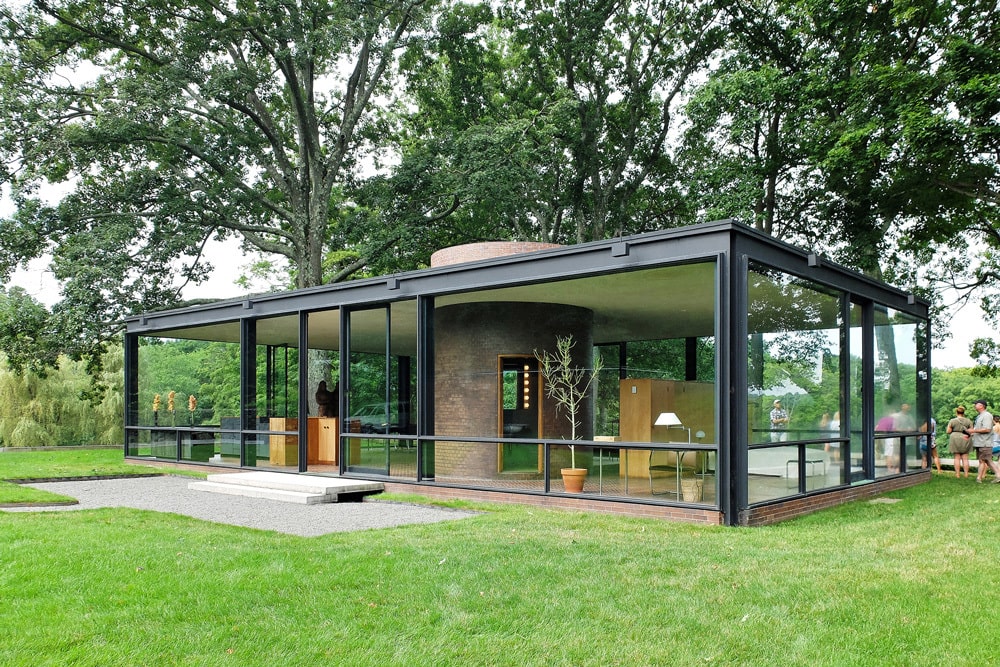
Philip Johnson built this house for himself in 1949 in New Canaan, Connecticut. It is modest in size: about 56 by 32 feet (17 by 10 meters) in plan and 10.5 feet (3.2 meters) tall. Every wall is glass in a slim steel frame. The only opaque element is a brick cylinder that holds the bathroom and the fireplace. The kitchen, bed, and living area are defined by furniture and cabinets alone, with no partitions.
The house is all about the shift between day and night. In daylight there is no boundary between interior and landscape; after dark, the glass reflects the lamps and the space turns inward. Privacy comes not from curtains but from the land: a 49-acre estate where the house sits far from any neighbor. Johnson lived and worked here for more than half a century, until his death in 2005, and since 2007 the house has been open to visitors as a site of the National Trust for Historic Preservation.
The Eames House
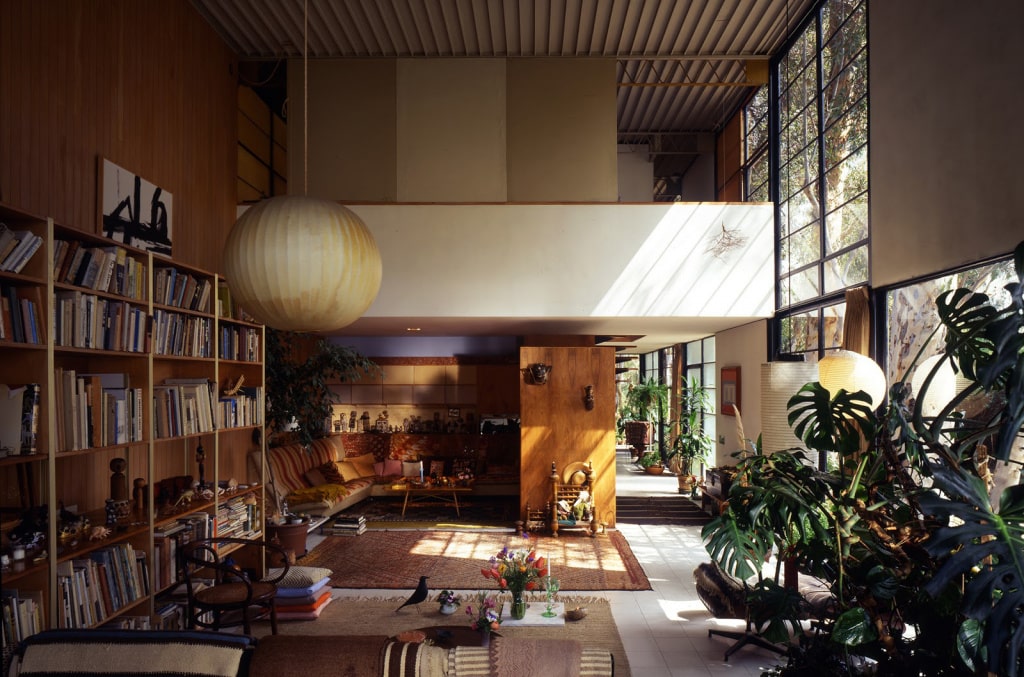
Another glass house from 1949, designed by Charles and Ray Eames - a married design partnership. Officially Case Study House No. 8 in Pacific Palisades, Los Angeles, it was assembled from standard, off-the-shelf industrial steel and glass components ordered from catalogs, which makes it as economical in construction as it is minimal in form.
The building is made of two rectangular volumes, a residence and a studio, with a courtyard between them. Its colored and white panels are often compared to Piet Mondrian's paintings. Unlike Johnson's house, it offers plenty of enclosed space for privacy. The Eameses lived and worked here for the rest of their lives, and in 2006 the house was designated a National Historic Landmark. More about the designers themselves in our article on Charles and Ray Eames.
The New National Gallery

The Neue Nationalgalerie in Berlin was designed by Mies van der Rohe himself. He received the commission in 1962, at 76, and the gallery opened in 1968. It is his last completed building and the only one he built in Germany after emigrating to the United States in 1938.
The gallery is a glass hall under a square steel roof measuring 64.8 by 64.8 meters. The roof rests on just eight cruciform steel columns, two on each side, set outside the glass line, so the hall has no internal supports at all. This is Mies's "universal space": a single room that can be rearranged for each new exhibition. The permanent collection lives on the lower level. Between 2015 and 2021, David Chipperfield Architects carried out a careful restoration that kept almost every original element.
Finlandia Hall
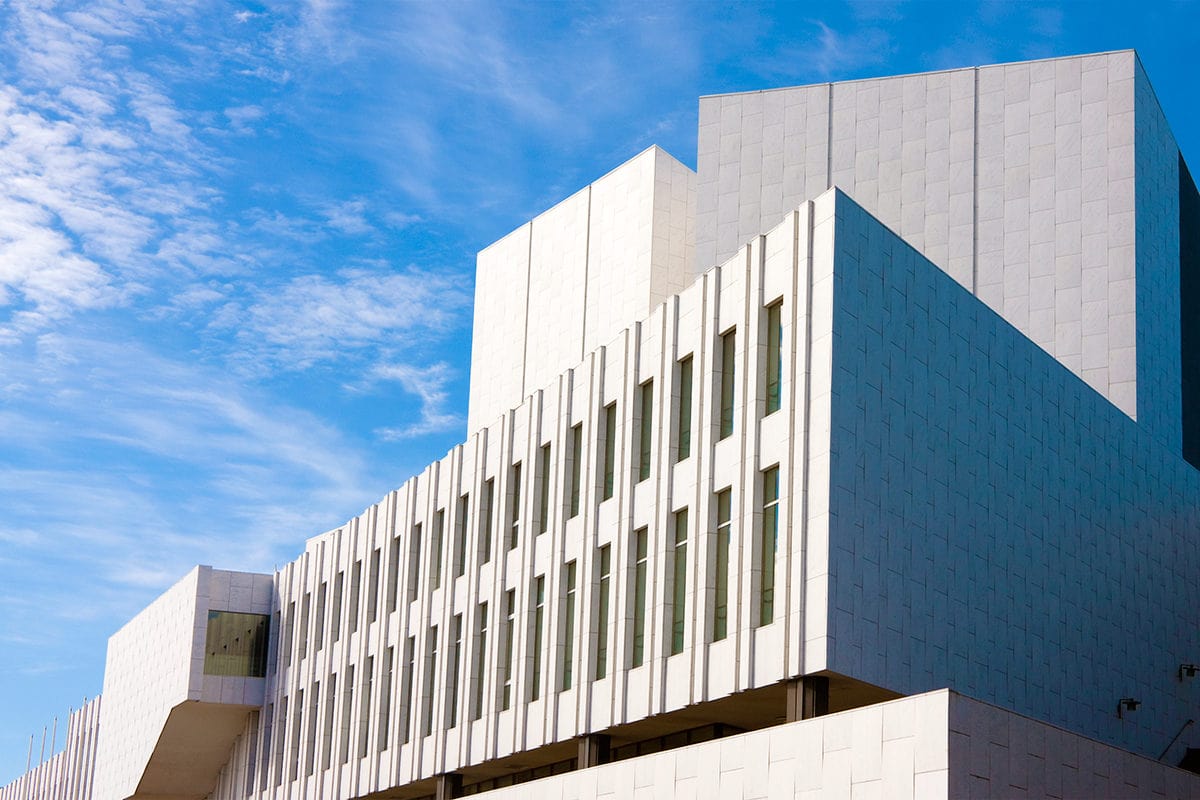
Alvar Aalto wanted the building to remind visitors of the clarity and freshness of the music performed inside. The concert hall was completed in 1971 and the congress wing in 1975. The facades combine white Carrara marble with black granite, and that contrast is what makes the hall read as a "white cliff" on the shore of Töölö Bay.
Aalto is not the strictest minimalist - his work has more sculpted, softer lines than Mies's. But the white monolithic mass, large undecorated planes, and carefully managed daylight make Finlandia Hall an important example of Nordic minimalism. It also carries a practical lesson: the thin marble panels did not cope well with the Finnish climate, bowed, and had to be replaced. A facade material has to be tested against the climate, not only judged on looks - in Seattle that means rain, moisture, and freeze-thaw cycles.
The Langen Foundation
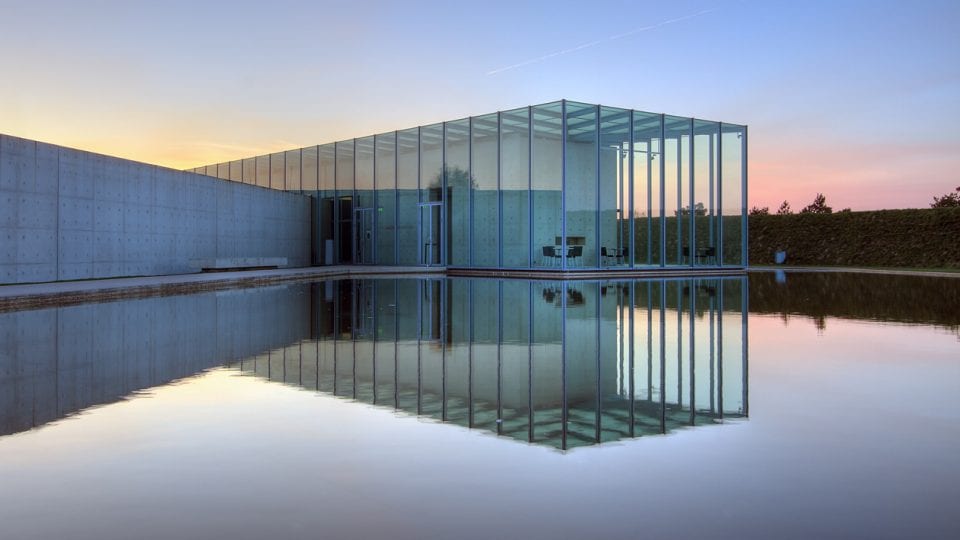
Japanese architect Tadao Ando, one of the leading minimalists of our time, designed the foundation's building in Neuss, near Düsseldorf. The museum opened in 2004 on the grounds of a former NATO missile base, the Raketenstation Hombroich. Ando used his signature move: a concrete volume enclosed in a glass shell, fronted by a reflecting pool.
Thanks to the reflection and the play of light, the concrete volume seems to float above the ground. Ando sank part of the galleries into the earth so the building would not dominate the flat landscape. It shows another core principle of minimalism: very few materials, each executed to perfection.
The Sumida Hokusai Museum
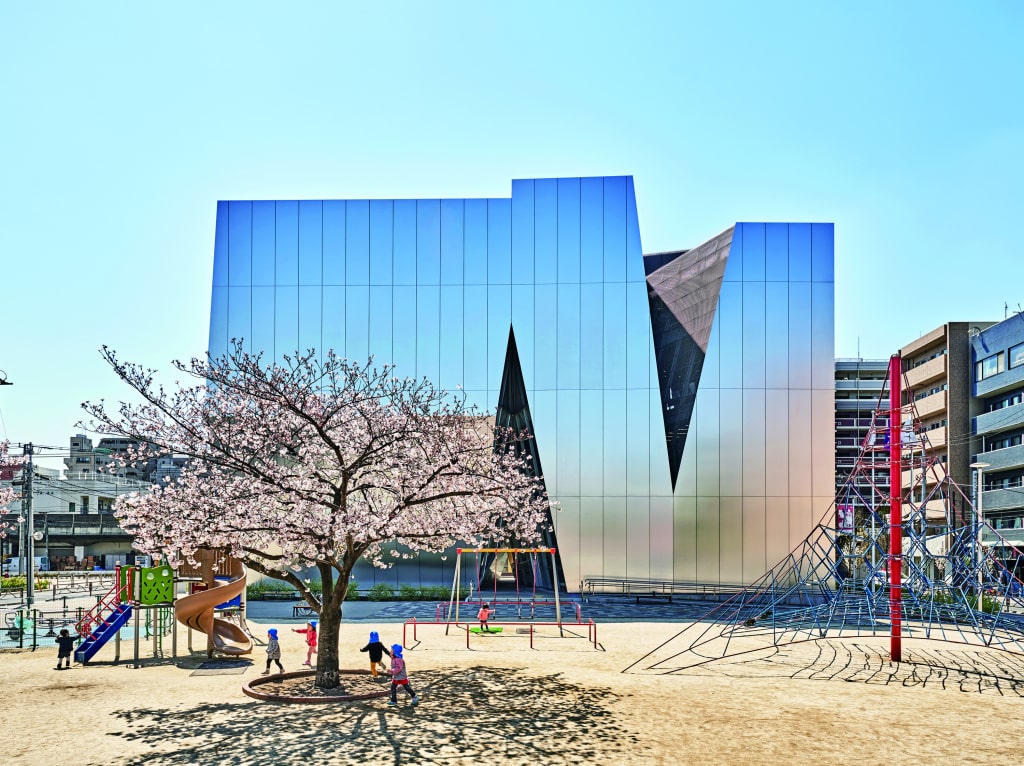
The museum dedicated to Katsushika Hokusai opened in November 2016 in Tokyo's Sumida ward, where the artist was born and spent most of his life. It was designed by Kazuyo Sejima, who shared the 2010 Pritzker Prize with her partner Ryue Nishizawa (SANAA). The building is clad in matte aluminum panels that softly reflect the city around it.
Deep wedge-shaped slits cut through the volume, so the museum can be approached from any side, and the slits become passages between the streets and a small park. It draws visitors with its form as much as its collection, fitting into a dense neighborhood without overpowering it.
Apple Park

Apple's headquarters in Cupertino was designed by Foster + Partners together with Steve Jobs, who worked on the idea from the late 2000s but did not live to see it finished. The campus opened in 2017. The main building is a four-story ring about a mile around, wrapped around an interior park, and it houses roughly 12,000 employees.
The facades and many interior partitions are glass, and soon after opening, markers had to be added to glass doors because employees kept walking into them. Besides offices, Apple Park includes cafes, a fitness center, conference facilities, and the Steve Jobs Theater. The roof carries about 17 megawatts of solar panels, and the campus runs on renewable energy. According to Apple, the naturally ventilated building needs no heating or air conditioning for about nine months of the year, with mechanical systems kicking in only at the extremes.
What These Buildings Have in Common
- Structure as the main means of expression. Columns, roof, and walls all do real work and hide nothing.
- Few materials. Glass, steel, concrete, or stone - two or three materials for the whole building, no ornament.
- Light and view. Large glazed planes, careful orientation, and a direct relationship with the landscape.
- Open plan. Zones are defined by furniture and levels rather than partitions.
- Precise execution. Minimalism has no casings or baseboards to hide a sloppy joint.
Minimalism in a Private Home: What It Really Takes
A minimalist house looks simple, but the simplicity is paid for in the details. Flush doors (see our article on concealed doors), shadow gaps instead of baseboards, hidden curtain tracks, and built-in storage (see cabinet furniture) all need drawings and construction precision from day one. The fewer objects in a room, the more each one matters, which is why careful material selection is essential.
Minimalism does not have to feel cold. Warmth comes from natural wood, textiles, and soft light, which is the whole idea behind Japandi. In our own work you can see this approach in Ascetic-House and its interior, the house in the village of Yuzhny, and Embracing Silence: The Enchanting One-Bedroom "Minimalism House" in the Carpathians.
Minimalism in the Pacific Northwest
Seattle has its own minimalist tradition: Northwest modernism, with wood, deep roof overhangs that shed rain, and big windows that pull in the soft, often overcast light. A glass-heavy house here has to work with the Washington State Energy Code, which sets strict thermal limits for windows, so large glazing usually means high-performance double or triple glazing, thermally broken frames, and good air sealing. Rainscreen facades and carefully flashed openings matter as much as the clean lines, and on steep or wooded lots, critical-area rules can shape where the house can sit. We design custom homes with these constraints built in from the first sketch.
Frequently Asked Questions
Who said "less is more"? The phrase became Ludwig Mies van der Rohe's motto, though it first appears in a Robert Browning poem from 1855.
Is a minimalist house cheaper to build? Not necessarily. A simpler form can save on structure, but precise detailing, large glazing units, and concealed systems cost more than standard solutions.
Won't a minimalist interior feel cold? Not if clean forms are paired with natural materials, textiles, and warm light.
How is minimalism different from Japandi? Japandi is a warmer take on minimalism, combining Japanese restraint with Scandinavian comfort and using more wood and texture.
Want a home in this spirit? We design custom homes from concept to construction documents.


