The buildings we live and work in affect our mood more than we tend to think. Neuroscientists and psychologists are studying how architecture acts on the brain, and their conclusions line up: a space should offer a sense of safety, plenty of light, and enough interest that it never becomes boring. In this article we look at what architecture needs to do to support mental well-being rather than wear it down, and what you can take from that for your own home.
Contemplation: Architecture That Calms
Almost everyone knows places where it's easy to think and breathe: often churches, libraries, or museums. Professor Julio Bermudez of the Catholic University of America set out to test this scientifically. In his study, architects looked at photographs of buildings designed for contemplation and of ordinary buildings while their brains were scanned with functional MRI. The contemplative buildings produced a state resembling meditation: the brain quieted down and drifted less into internal chatter.
The buildings studied included the Pantheon in Rome, Chartres Cathedral, the Alhambra, Le Corbusier's chapel at Ronchamp, and secular buildings such as Louis Kahn's Salk Institute and Frank Lloyd Wright's Fallingwater. Bermudez suggests that spending time in such places could, over time, bring benefits similar to a regular meditation practice.
The Salk Institute for Biological Studies in La Jolla, California, is a striking case. Its founder, Jonas Salk, creator of the polio vaccine, wanted a laboratory where scientists could think as freely as monks in a monastery, and he drew inspiration from the monastery of St. Francis in Assisi. Louis Kahn answered with an empty travertine courtyard between two laboratory wings, cut down the middle by a narrow channel of water that seems to flow toward the Pacific. At sunset, the sun lines up with the axis of that channel, and the courtyard becomes one of the calmest places in modern architecture.
Interest: Why Boring Architecture Does Harm
Monotonous, featureless buildings don't just fail to please; they affect how we feel. In 2011, neuroscientist Colin Ellard of the University of Waterloo led walking experiments on East Houston Street in New York. Participants wore sensors measuring physiological arousal as they moved along a street of small shops and restaurants and then past the long, blank facade of a Whole Foods Market that filled an entire block.
In front of the supermarket, arousal dropped to its lowest point, and people described the place as "bland," "monotonous," and "passionless." On the lively street with bars and shops, they felt engaged and called it "lively" and "sociable." Ellard argues that a cityscape needs constant small changes, one impression giving way to the next, to keep people engaged. Chronic boredom, he says, is linked to stress, something many people feel when they spend every day in a monotonous environment.
Interesting architecture doesn't have to mean ornament. Norman Foster's Hearst Tower in New York (2006) is a good example: a faceted diagrid glass tower rising from a preserved 1928 Art Deco base. The contrast of old and new, the rhythm of the facets, and the play of light through the day make it expressive without a single unnecessary decoration.
Safety: Why People Love the "Ugly" Barbican
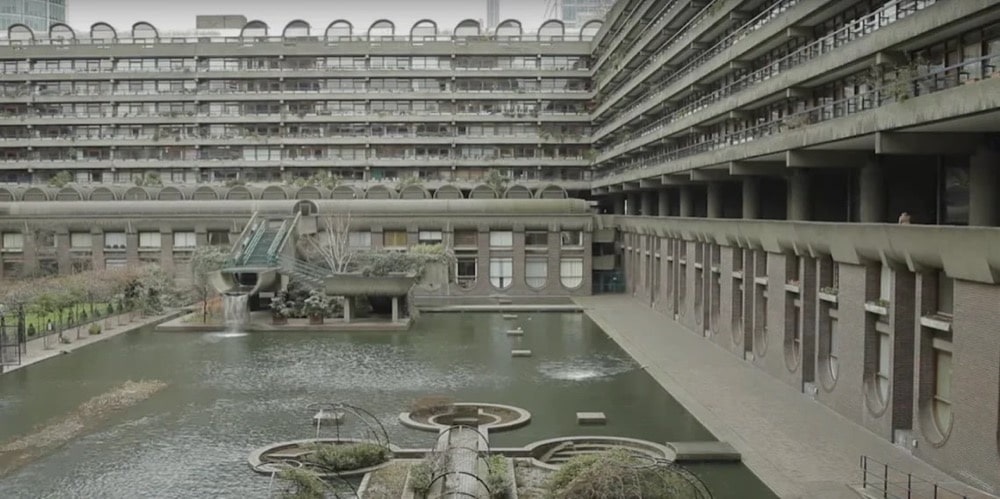
"Don't judge a book by its cover" applies to buildings too. A place can look forbidding and still have a waiting list. London's Barbican Estate, built between 1965 and 1976 to designs by Chamberlin, Powell and Bon, is the classic example. Many people consider its massive concrete walls among the bleakest sights in the city, yet its apartments are in high demand, and the estate has been a listed landmark since 2001.
The secret is a sense of safety. Cars stay out: pedestrians move along raised walkways, and the complex encloses gardens, a lake with fountains, a tropical conservatory, a music and drama school, a girls' school, and a major arts center. Layla McCay, director of the Centre for Urban Design and Mental Health in the UK, lists green and blue spaces, places for active and social life, and a sense of safety among the factors that support mental health in cities. The Barbican combines all of them, which is why it protects residents from stress better than many prettier neighborhoods.
Togetherness: Architecture Against Loneliness
Doctors and psychologists agree that a lack of social contact harms both mental and physical health. There's a common belief that people in single-family neighborhoods are closer than apartment dwellers who barely know their neighbors. Seattle architect Grace Kim argues that a detached house is no cure for loneliness.
Her answer is cohousing. Kim designed Capitol Hill Urban Cohousing in Seattle and lives there herself: 28 people in nine households. Each family has its own apartment, but they share generous common spaces, including a courtyard where children play and a kitchen and dining room where neighbors cook and eat together several times a week. What distinguishes it from a dorm is choice: people opt into shared living deliberately. In her 2017 TED talk, Kim described retired neighbors without grandchildren of their own who look after other families' kids while their parents are at work.
Light: How It Shapes Mood
A lack of daylight is one of the drivers of the winter blues and seasonal affective disorder. Short winter days disrupt the body's internal clock, and dim interiors make it worse.
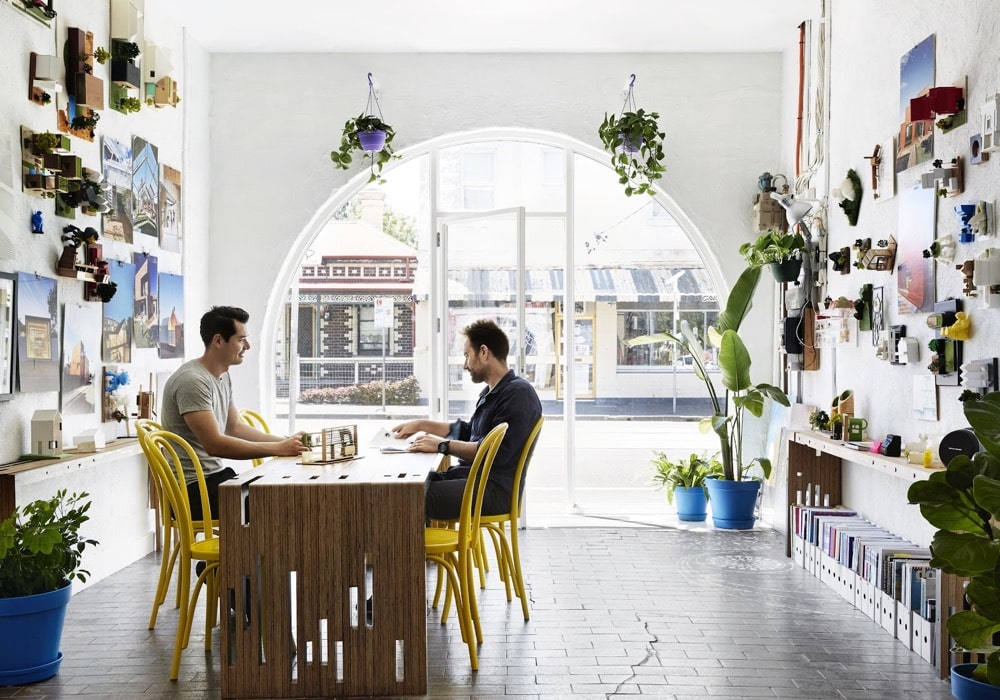
Melbourne architect Andrew Maynard has described how, during therapy for anxiety, his doctor asked what his house was like. In winter he had to switch the lights on by 4 p.m., and some rooms were dark even in summer. Maynard opened up a large archway between rooms, repainted the interior in yellow and white, and glazed the terrace to open the view to the garden. He doesn't consider the house perfect - the big windows mean more heating - but he says the changes helped him manage his anxiety and feel connected to nature.
Nature Close By
One of the best-known studies on how space affects people comes from architect and researcher Roger Ulrich. In 1984 he published findings in the journal Science on patients recovering from surgery: those whose windows looked out on trees recovered faster, needed fewer strong painkillers, and received fewer negative notes from nurses than patients whose windows faced a brick wall. Many studies since have confirmed that views of greenery, natural materials and textures, water, and daylight lower stress. That is the foundation of biophilic design: wood, stone, plants, garden views, and natural colors in an interior are not just aesthetics but care for the nervous system.
What to Take Into Your Own Home
- One contemplative spot: a chair by a window with a view of a tree or the sky, a quiet corner without a screen.
- Variety without chaos: different ceiling heights, textures, and views keep a space alive.
- A sense of shelter: a clear entry, bedrooms in the quiet part of the house, good acoustic separation.
- A place to gather: a generous kitchen and dining space matters more to a family than one more spare room.
- As much daylight as possible, plus thoughtful artificial lighting for the dark months.
- Natural materials and greenery: wood, stone, textiles, living plants, and a garden view where you spend the most time.
- Order and storage: clutter keeps a space visually noisy, so well-planned storage is also about calm.
Light and Well-Being in the Pacific Northwest
Seattle residents know the issue well: around the winter solstice the city gets only about eight and a half hours of daylight, often under heavy cloud. Designing for well-being here means pulling in as much daylight as possible - skylights and clerestories, light-colored interiors, rooms that face south or west where you spend the most time - and pairing it with warm, layered artificial light rather than a single harsh ceiling fixture. Covered outdoor spaces matter too, because they let you get outside even when it's drizzling. And Grace Kim's cohousing shows that the region's housing debates aren't only about density: Washington's newer middle-housing rules open the door to more shared and multigenerational forms of living. See our article on biophilic design in Seattle and our interior design services.
Frequently Asked Questions
Does architecture really affect mental health? Yes. Studies using MRI and physiological sensors show that different spaces affect arousal, stress, and focus in measurably different ways.
What matters most for a calm home? Daylight, quiet, a sense of shelter, and at least one place where you can be alone.
What is cohousing? A form of housing in which each household has its own home, but residents share a kitchen, dining room, and outdoor space and deliberately spend part of their time together.