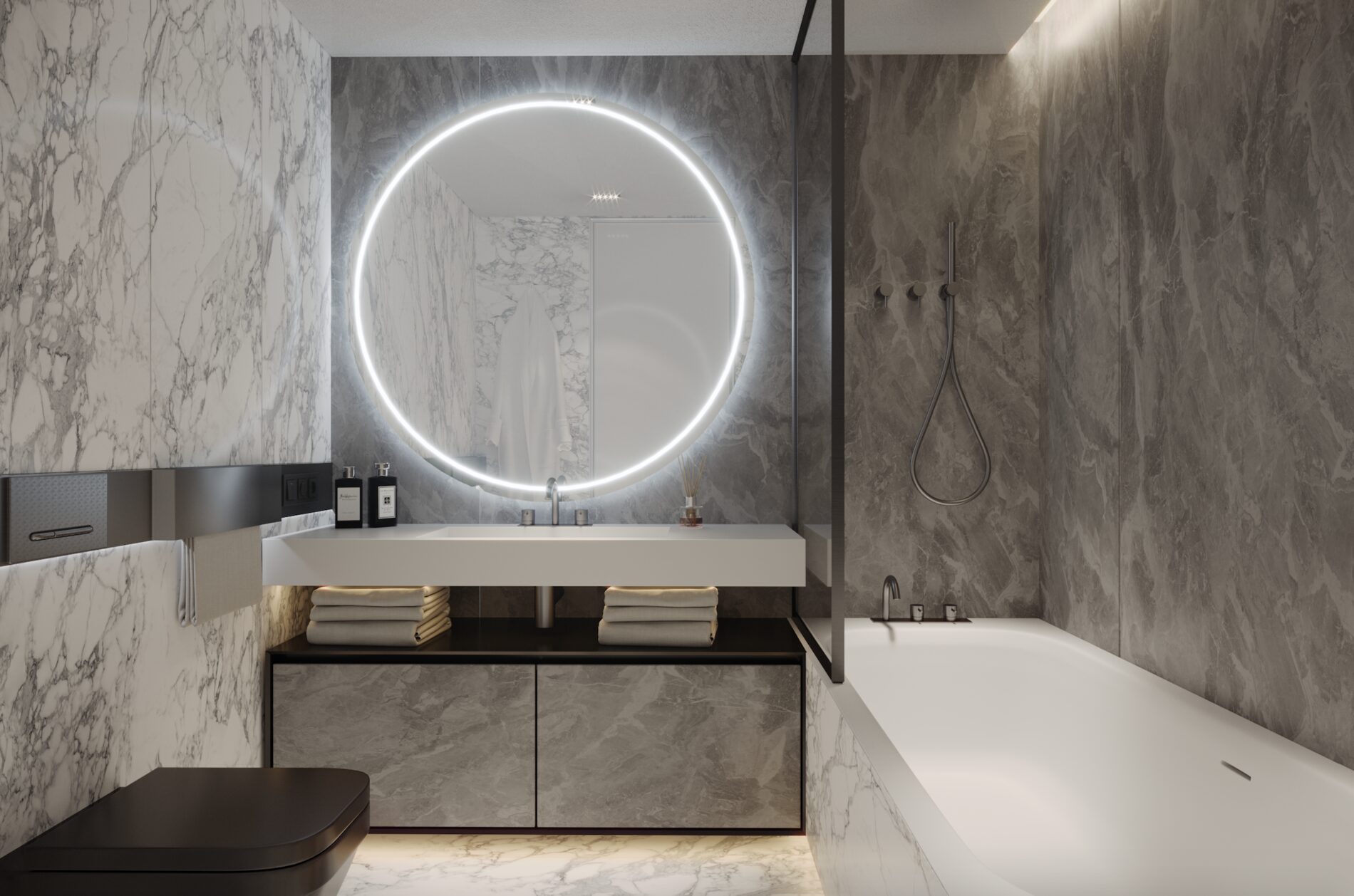
Material selection for Seattle, Bellevue and Kirkland homes: finishes as a sequence of decisions
Every finish in a house answers several questions at once: how it looks beside its neighbors, how it wears in your household, what it costs once installed, when it can arrive and who will look after it. DeZZign selects floors, wall finishes, tile and stone, worktops, cabinet fronts, hardware and plumbing fixtures for houses, condos and commercial interiors in Seattle, Bellevue and Kirkland. The service works on its own, from your floor plans, a mood board or a general style direction, or as part of a full design project. You receive a finish schedule and a material board with product names, finish codes, supplier contacts, unit prices and lead times, so the contractor can price and order without guessing.
One example from our own work is the interior of House for Cosmopolitan, a private residence in the Kharkiv region of Ukraine, set in pine forest near the Saltivske Reservoir (2019 to 2021). There DeZZign was responsible for the interior design and for its realization: construction, material selection, furniture and lighting. The palette rests on stone, wood, glass and metal. In an interior that restrained, every junction and transition shows, so the materials were coordinated with the built-in elements, furniture and lighting all the way through construction.
In what order to choose interior finishes
Selections go wrong when they follow the order of showroom visits. We work from the surfaces that are hardest to change toward the ones that are easiest:
- floors, because they cover the most area, run from room to room and set the finished floor level that doors, thresholds and showers depend on;
- walls in tile, stone, panelling or plaster, chosen against the floor;
- wet areas, where tile, grout, the waterproofing system and the drain form one decision;
- worktops, once the cabinet layout and the appliances are fixed;
- cabinet and joinery fronts, matched to the worktop and the floor in daylight;
- hardware and the metal finish of faucets, handles and light fittings, held to one family per room or to a clear rule;
- paint and window textiles last, since a paint color can be mixed to match a stone, while a stone can never be ordered to match a paint chip.
Floors lead for a technical reason as well. Porcelain tile on adhesive, an engineered board on its underlayment and a thin glue-down vinyl each build up to a different height. Wherever two of them meet, someone has to decide whether the subfloor is raised, a transition strip is used or the levels are made flush. That choice belongs in the drawings, before the framer and the plumber set their own heights.
Samples, material boards and screens: approving finishes in your own light
A screen is a poor judge of a finish. Monitors and phones show the same file in different colors, and a rendering shows one photograph of a stone that will arrive as other slabs with veining of their own. Our interior renderings settle composition and the relationships between colors; the finish itself is approved from physical samples.
Where a sample is seen matters as much as the sample. Two colors can match under showroom LEDs and part ways in daylight, an effect called metamerism. Seattle's cool, overcast light for much of the year pushes grays toward blue and makes warm whites look cleaner than they did in the store. So we look at samples at your address, by the windows and under the bulbs you will actually use, in the morning and again after dark. A paint chip the size of a stamp misleads as well, because a color spread across a whole wall reads lighter and stronger, and we paint large swatches before the order goes in.
The material board brings each room together: real samples side by side, at roughly the proportions they will occupy, with their codes on the back. For natural stone, a sample is only a hint. Natural stone is chosen at the yard: the actual slabs are selected, tagged and photographed, since veining and tone change from block to block and from slab to slab.
Mock-ups on site before a whole room is finished
Some finishes depend on the hand as much as on the product. Microcement and decorative plaster are trowelled by hand, and their clouding and trowel marks vary from one applicator to the next. Before a whole room is done, we ask the applicator who will do the work for a sample panel in the actual room, with the chosen sealer, and that panel becomes the reference everyone checks against. Stained wood floors get the same test, since a stain looks different on your species and cut than on a showroom board.
Tile gets a dry lay. A few rows set out without adhesive show the joint width, the grout color and where the pattern starts, so a herringbone does not end in a sliver at the front door and a large slab joint does not land on a shower valve. Grout is approved on that mock-up too: a contrasting joint draws the grid, and a matching one lets the floor read as a single surface. Changing a grout color costs nothing at this stage and a full regrout later.
Laminate, vinyl, engineered wood or porcelain: choosing a floor for each room
Flooring is what clients ask about most, and our comparison of laminate and vinyl flooring covers the two materials point by point. In short, laminate has a wood-fiber core and a wider range of designs, and its abrasion class tells you how it wears: AC3 suits most rooms, and for entries, open kitchen-living areas and homes with children or dogs we recommend AC4 or higher. Vinyl is fully water-resistant, quieter underfoot and better suited to radiant heat. Rigid SPC vinyl tolerates swings in temperature and humidity, while WPC is softer and dents more easily.
Then each room gets its floor. Kitchens, bathrooms, mudrooms and basements, where wet boots and the occasional leak are part of life here, get porcelain or vinyl. Bedrooms and living rooms can take engineered wood or high-grade laminate. Engineered wood, a real wood wear layer over a cross-laminated core, moves far less with humidity than solid boards, which counts in a climate that stays damp outside for months while the heating dries the air inside. In a condo, many associations set minimum sound ratings for floors, so the underlayment is part of the selection, and we read the association's rules before anything is ordered.
Two different floors can also meet in one plane. In the minimalist apartment in Kharkiv, Mirage porcelain and vinyl join so closely that the transition is hard to see without looking carefully, and the case says plainly that finding textures and colors that worked together took considerable time.
Durability against looks: children, pets, rentals and busy kitchens
The right finish depends on who lives with it. Our working rule is to picture what happens to a surface on a bad day, then pick the best-looking option that survives it:
- Children: washable eggshell or satin paint instead of flat in halls and bedrooms, matte or textured fronts that hide fingerprints, and worktops that forgive felt-tip pens and juice.
- Dogs and cats: claws mark soft oiled wood and glossy lacquer first. A lighter, matte, brushed floor or porcelain hides wear far better than a dark polished one, and urine left on laminate seams swells the wood-fiber core.
- Rentals: a floor that can be repaired plank by plank, a standard paint color the next painter can buy, and spare tile boxes kept for repairs.
- Cooks: marble is calcium carbonate and etches under lemon juice, vinegar or wine. Quartzite is a natural metamorphic rock harder than granite, while engineered quartz is crushed quartz bound with resin, non-porous yet sensitive to direct heat.
Kitchen details, from backsplash heights to sink cut-outs, are on our kitchen interior page, and the stone options are compared in Stone Kitchen Backsplashes: Comparing Your Material Options. Tile layouts and waterproofing in wet rooms belong to bathroom design. In Residence 11 the kitchen fronts and worktops are large-format Laminam porcelain, which the case describes as resistant to scratches, chemicals and temperature changes.
Maintenance: what each finish asks for over the years
Upkeep is part of the price. We write it into the schedule so the household, and anyone who cleans for it, knows what each surface needs:
- natural stone takes a penetrating sealer after installation, renewed on the interval the sealer's maker gives; water that darkens the stone within minutes says the time has come;
- oiled wood allows easy spot repairs and needs fresh oil every few years, while lacquered wood resists spills better but has to be sanded and recoated once worn through;
- microcement wears through its sealer first, so the sealer is renewed in busy areas;
- porcelain asks for almost nothing apart from its grout, and epoxy grout makes that easier;
- unlacquered brass darkens with touch by design, while PVD-coated hardware keeps its color.
Cleaning products are the hidden enemy. Acidic limescale removers etch marble and limestone and can dull some grouts, and many laminate and vinyl makers do not approve steam mops on their floors. A one-page care sheet per material often does more for a finish than an upgrade.
The finish schedule: the document the contractor prices and buys from
A mood board says what a room should feel like, and a finish schedule says what to buy. For every surface in every room, ours lists:
- the product, maker, collection and color or finish code;
- format, thickness and surface: polished, honed, structured or brushed;
- net area or count, and the overage to add;
- joint width, grout or sealant color, and the trims at edges and transitions;
- lay direction and the start point of the pattern;
- the setting materials or system the maker requires;
- supplier, unit price and lead time, with an approved alternative where one exists.
Our article 68 Sheets: What an Interior Design Project Actually Includes shows the flooring plan of that minimalist apartment: Mirage Master Naturale porcelain at 200×1200 mm, 33.66 m²; vinyl flooring, 73.55 m²; Mirage Fancy Naturale at 1200×1200 mm, 2.74 m²; Mutina Nero at 1200×2400 mm, 7.98 m². Those areas are net, and overage is added before ordering. Each tile is ordered from a single batch, because batches differ slightly in shade and size, and a top-up months later rarely matches. Leftover boxes stay with you as attic stock for future repairs.
For cabinetry and floors with composite wood cores, we ask for the TSCA Title VI label: since March 22, 2019, the EPA has required hardwood plywood, MDF and particleboard to be labeled as compliant with its formaldehyde emission standards, and the rule also covers finished goods made from them. Finishes are better priced as real products than as contractor allowances. An allowance is a placeholder sum, and when the product you finally choose costs more, the difference comes back as a change order.
Lead times, availability and how to compare a cheaper substitute
Some imported tile and stone takes 8 to 16 weeks from order to delivery in this market, so the selections that affect rough-in are fixed early in the drawings. Local stock helps: many porcelain, engineered wood and vinyl lines are held in regional warehouses, and Pacific Northwest species such as Douglas fir and alder are grown and milled in the region. Italian slabs or a specialty plaster cannot be hurried, so we confirm stock with the distributor before you approve a sample, rather than after. Collections are also discontinued without warning.
When a contractor proposes a substitute, we compare it line by line instead of by the price per square foot. A substitute counts as equal only if it matches:
- format and thickness, since both change floor levels and the layout;
- water absorption, slip resistance and abrasion class for that room;
- color range and shade variation, checked on a physical sample;
- trims, setting materials and the maker's installation requirements.
Then we compare installed cost: material plus overage, setting materials, labor, trims, sealing and upkeep over the years. A cheaper large-format tile that needs a leveling system and more adhesive, or a pattern that needs more overage, can cost more on the wall than the product it replaced. Sometimes the cheaper option holds up perfectly well, and then we say so. A label can mislead too: porcelain means water absorption of 0.5% or less, the threshold of the US standard ANSI A137.1, so a ceramic tile printed to look like porcelain is no equal on a shower floor.
Seattle damp, moss and the surfaces outside the door
Selections continue past the threshold. Around Puget Sound, outdoor surfaces stay wet for months, shaded north sides grow moss and algae, and hard frost is occasional, so the test is how a surface drains and dries. For a covered entry or a terrace we choose textured porcelain pavers or stone with a slip rating for wet use, laid to a fall, and we avoid polished finishes that turn slick under a film of algae. Wood decking needs air beneath it and fasteners that will not stain the boards. Thermally modified wood, used on the exterior of House for Cosmopolitan, weathers to silver unless it is treated, so its color is chosen with that change in mind.
Cladding belongs to facade design, which compares materials for Seattle rain. One of them, fiber cement, shows why exterior colors are easier to settle at selection stage: its color comes from a factory coating or from field paint, cut edges need sealing, and the color and the coating system are specified together.
What moves the fee, and how we keep the finish budget in hand
Cost, time and supervision for this service are discussed individually. As a starting point, the cost answer on this page says that fees for a single bathroom or kitchen start from $800-1,500, and that full-home material selection is priced individually. The fee follows the number of rooms and surfaces, how much natural stone has to be chosen slab by slab, how many items are imported, whether you need us at suppliers and stone yards, and whether we also place and track the orders.
Budget control starts before the first sample. We split the finish budget into lines (floors, tile and stone, worktops, fronts, hardware and fixtures, paint) and keep each choice inside its line. Savings go where they do no harm: a guest room floor, a wall nobody touches, a simpler tile inside a closet. They never go into waterproofing, adhesives, the substrate or the hidden body of a shower valve, all of which are expensive to reach once the finish is on. When a line runs over, we show two or three alternatives with their installed cost, and you decide.
When material selection fits, and when another service fits better
Material selection fits when the layout is settled and the open question is what to build it from: a remodel drawn by another designer, a new house whose builder needs a finish schedule, a condo refresh, or a project where the samples you collected no longer add up. It also works as a check before you sign a contractor's price. If the rooms themselves still need planning, start with interior design, where materials come inside the full drawing set. Sofas, beds, tables and rugs are chosen in furniture selection, from the same palette. For a kitchen or a bathroom whose plumbing and cabinetry are still open, the room pages linked above go further than this one, and exterior cladding starts with facade design.