
A stone backsplash is the hardest-working wall in a kitchen and usually the most visible one. It takes grease, steam, water and heat from the range, gets wiped down every day, and sets the tone for the whole room. Here's an honest rundown of the most popular stone and stone-look options from the deZZign team - natural stone, engineered quartz, solid surface, large-format porcelain and ceramic tile - based on what our designers and architects specify every day.
The short version: there is no single best material. There is the right material for your cooktop, your cleaning habits, your light and your budget, and most of those decisions need to be made at the design stage, not on installation day.
Natural Stone: Marble, Granite, Onyx and Quartzite
Natural stone has a lot going for it. It looks striking and expensive because it's made by nature - the kind of pattern no person could design, and no two slabs alike. It's fire-resistant and can last for decades, but different stones behave very differently in a working kitchen.
- Marble is the most beautiful and the most demanding. It's porous and reacts with acids: lemon juice, vinegar or wine leave dull etch marks. A marble backsplash has to be sealed and resealed roughly every one to two years, and a honed finish hides etching far better than a polished one.
- Granite is denser and more forgiving with stains, scratches and heat, which makes it one of the most practical natural options, including behind a gas range.
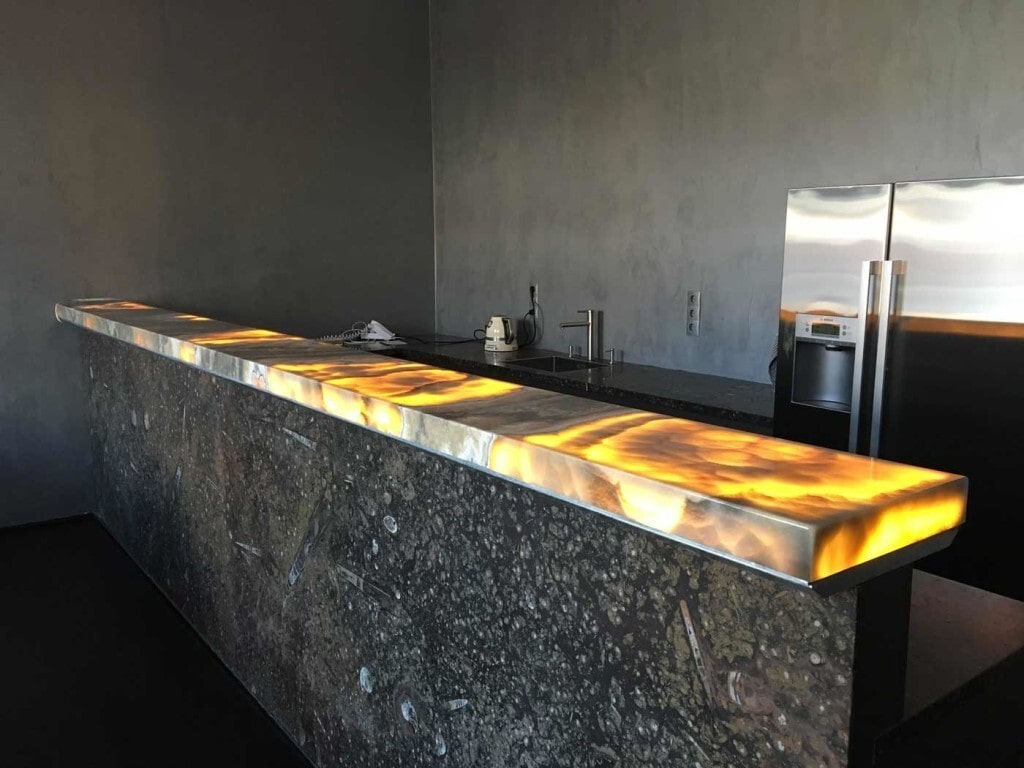
- Onyx is translucent. You can backlight it, so the backsplash itself becomes the light source without adding a separate fixture. It's softer and more delicate, so we keep it away from the cooktop.
- Quartzite is a natural metamorphic rock, harder than granite. It's often confused with engineered quartz, but the two are completely different materials. Some stones sold as quartzite behave more like marble, so it's worth testing a sample for scratching and acid reaction before you commit.
Natural stone works best across a large surface area. Good lighting brings out the material's character, and it pairs beautifully with live plants and high-end textiles.
Engineered Quartz
Engineered quartz is roughly 90% crushed quartz bound with polymer resin. It's non-porous, doesn't absorb oil or colored liquids, never needs sealing, and has a consistent pattern, which makes it easy to match panels across a large kitchen.
The weak point is the resin. It doesn't like direct heat: hot pans and an open flame right against the backsplash can leave marks, so behind a gas range we keep a clearance or switch to another material for that section. Some lighter colors can also yellow over time in strong direct sun.
There's one more thing worth knowing. Cutting engineered stone releases fine silica dust, which is dangerous for fabrication workers. Australia banned engineered stone from July 2024 over silicosis cases, and US regulators have tightened oversight of fabrication shops. A finished backsplash is safe to live with, but it's fair to ask your fabricator whether they wet-cut and control dust.
Solid Surface (Acrylic)
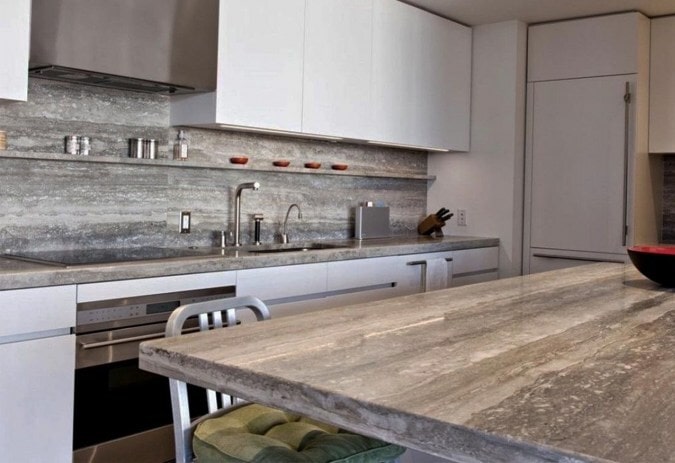
Solid surface materials such as Corian, HI-MACS and Staron are durable and very flexible - used not just for backsplashes but for countertops in kitchens and bathrooms alike. The big advantage is seamlessness: joints between sheets disappear, and the sink can be formed from the same material as one piece with the countertop.
It looks expensive without demanding much upkeep, and scratches and minor damage can be polished out to like-new condition. Because it can be thermoformed, manufacturers use it for striking sculptural panels.
On the other hand, solid surface is sensitive to high heat and abrasive scratches, and strong solvents such as acetone damage it. We don't put it directly behind a gas range, and we leave a clearance next to induction.
Large-Format Porcelain and Sintered Stone
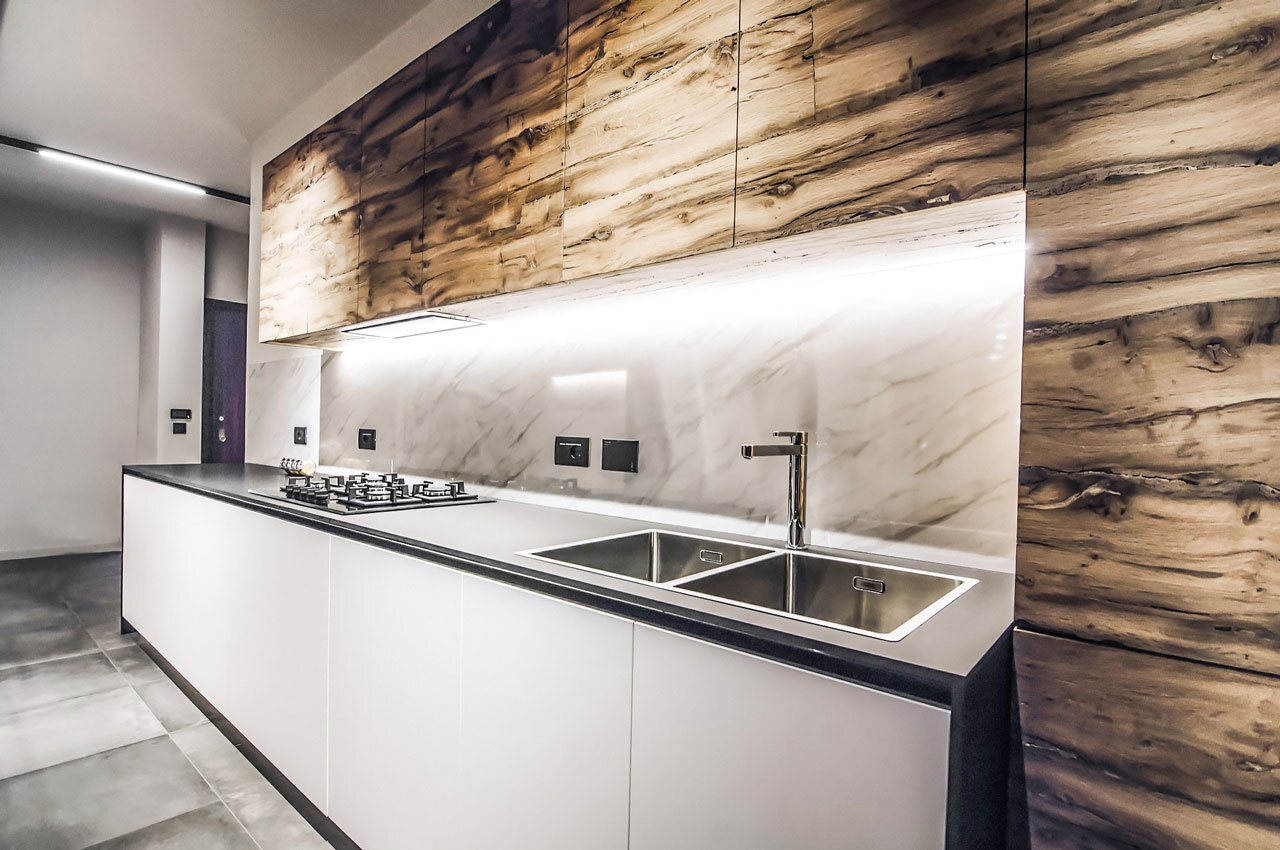
Large-format porcelain and sintered stone (Laminam, Neolith, Dekton and others) are the most versatile option for a modern kitchen. Slabs come over three meters long and only 6-12 mm thick, so a backsplash can be almost seamless. The material is heat-proof, stain-proof and UV-stable, and it reproduces marble, concrete or granite very convincingly.
It is demanding to install: edges are brittle, and cut-outs for outlets and rails need precise tools and an experienced installer. On our Residence 11 project we used large-format Laminam porcelain with a natural stone look in the living room and bathrooms - the same material works just as well on a kitchen backsplash.
Ceramic Tile
Ceramic is durable and reliable, and unlike solid surface, it stands up well to cleaning chemicals. It's easy to maintain thanks to its smooth surface, regular cleaning doesn't wear down its appearance, it's cheaper than stone, and it does a genuinely good job imitating pricier natural materials. We use ceramic often in deZZign projects specifically because it's more affordable, more practical, and easy to source quickly.
The only weak spot is the grout. Next to the range and the sink we use epoxy grout, which doesn't darken with grease or absorb water. We collected a few layouts that work in our guide to stylish ceramic tile combinations.
Backsplash Materials at a Glance
| Material | Behind a gas range | Stains | Joints | Budget |
|---|---|---|---|---|
| Marble, onyx | Yes, with care | Vulnerable | Minimal | High |
| Granite, quartzite | Yes | Resistant once sealed | Minimal | High |
| Engineered quartz | With clearance | Very resistant | Minimal | Mid to high |
| Solid surface | Not recommended | Resistant | Invisible | Mid |
| Porcelain, sintered stone | Yes | Very resistant | Almost none | Mid to high |
| Ceramic tile | Yes | Resistant, grout needs care | Many | Affordable |


