The winter of 2025-2026 was the hardest for Ukraine's energy system since 2011 - a combination of targeted strikes on energy facilities and abnormally cold weather left hundreds of thousands, and at times millions, of people without power, heat, and water at once, at temperatures of -20°C. Forecasts for the 2026-2027 heating season remain cautious, with short-term outages from strikes still a realistic scenario, and the government is directly urging people to prepare now.
This isn't an article about panic - it's about concrete engineering and design decisions: how to plan an apartment's layout so that a power, water, or heating outage doesn't turn into a crisis every single time.
New Construction vs. Older Housing Stock - Different Rules
There's a real legal distinction here that many people don't realize. The new edition of DBN B.2.5-23:2025, Ukraine's code for electrical installation design in residential and public buildings, now requires developers to build in backup power for a building's basic functions in new construction - not full energy independence for every apartment, but support for critical systems (elevators, emergency lighting, water pressure pumps) during emergency outages.
But if a building was designed and built before the new code took effect - which describes the vast majority of Ukraine's housing stock - responsibility for backup power falls to the building's homeowners association or management company, funded by residents. By law, a developer can't retroactively modify a building that's already been handed over, even if it's a later phase of the same complex. That's exactly why, for residents of older buildings, preparing at the apartment level isn't just a convenience - it's often the only real lever of control they have over their own safety.
Backup Power: How to Calculate It, Not Guess It
A portable power station doesn't generate electricity - it only stores it in a battery - so the calculation needs to come before the purchase, not from marketing claims. The formula is simple: required capacity (Wh) = total load (W) × desired hours of runtime, and you should always add a 20-30% buffer on top for conversion losses and the battery's gradual capacity loss over time.
Basic scenario - connectivity and light: a Wi-Fi router (≈15W), two LED lamps (≈20W), charging phones and a laptop (≈65W). Total load comes to about 100W. For 8 hours of runtime, that's roughly 800Wh, so a practical choice is a station rated at 1kWh or more.
Extended scenario - if you have an individual gas boiler, a heating circulation pump, lighting, and a router, you'll need a station in the 1.5-2kWh range or more, and this is exactly where the most common mistake happens: a boiler critically needs a pure sine wave output from the station, or its electronics may behave erratically or fail to start at all.
What to actually check when choosing one: continuous output power, peak power for pump startup (a pump's starting current is higher than its running current), pure sine wave output, battery chemistry (LiFePO4 has a substantially longer cycle life than standard lithium-ion), charging speed, solar panel compatibility, a dedicated UPS mode, and - something people often overlook - actual warranty service availability in Ukraine.
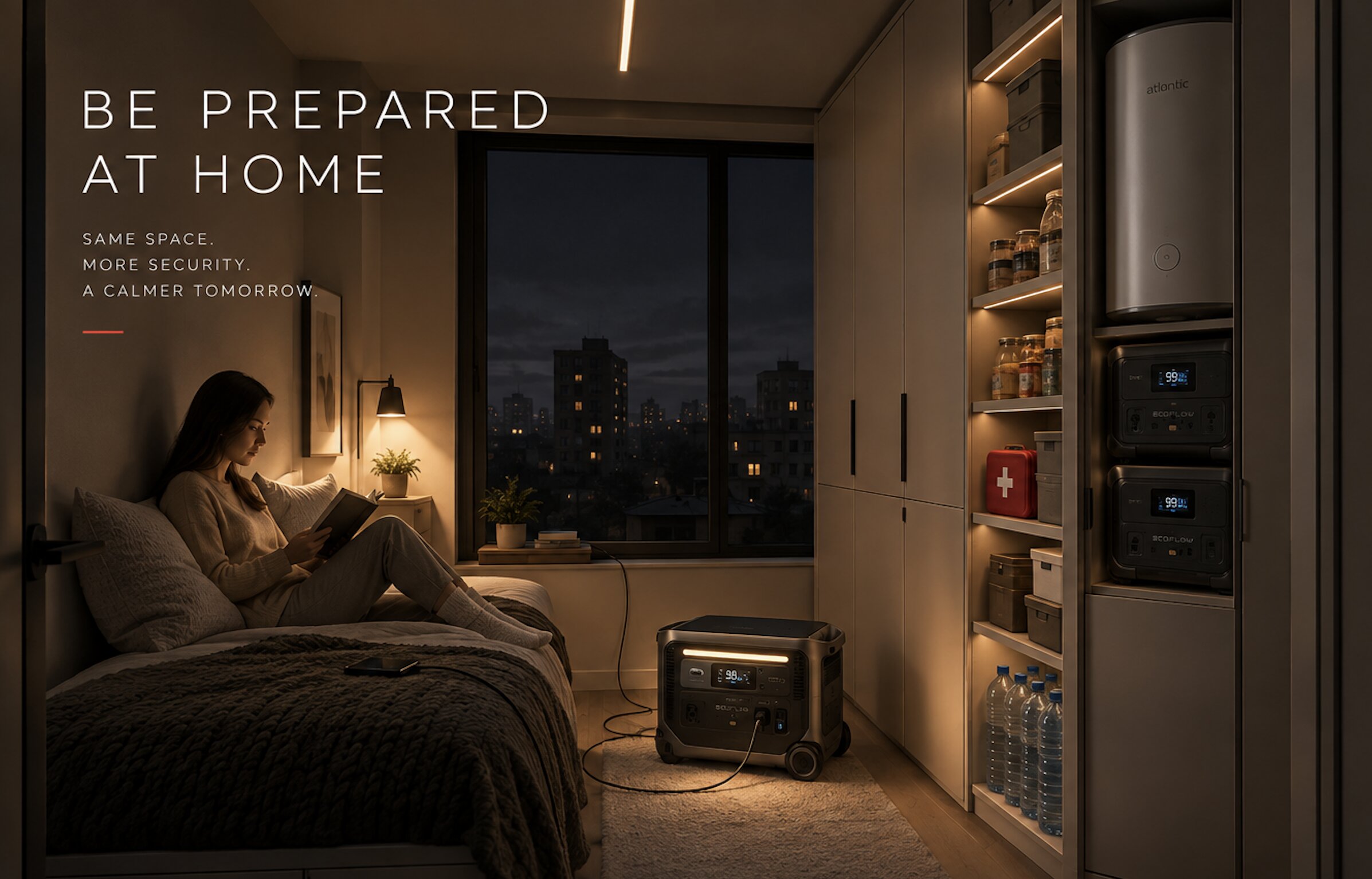
For a design project, this translates into a concrete practical decision: build in a dedicated outlet, or even a separate electrical circuit, for a power station at the electrical planning stage, rather than adding extension cords after the fact. It's the same engineering logic we apply in our interior design projects - everything gets planned upfront, not bolted on after a finished renovation.
Why a Generator Is Categorically Off-Limits in an Apartment
This is the single most important safety point in this entire article, and it deserves to be stated plainly: for an apartment, a generator isn't a "less convenient" backup option - it's categorically prohibited. In a multi-unit building, a generator cannot be installed even on a balcony, in a loggia, a stairwell, a basement, or a garage - carbon monoxide has no color or smell, and it can reach neighboring apartments through windows and ventilation ducts, including apartments belonging to people who have no idea a generator is running anywhere nearby.
The full list of what's categorically prohibited inside an apartment: a gasoline or diesel generator, a barbecue or charcoal grill, a camping burner used for heating a room, a gas stove used as a space heater, a homemade stove without a proper flue. The safest backup option for an apartment is a power station, or an inverter-and-battery system installed by a professional, supplemented if needed with a dedicated pure-sine-wave UPS for a gas boiler.
Carbon monoxide is called the invisible killer for good reason, not for dramatic effect - it genuinely has no smell, color, or taste, and its sources go well beyond generators: stoves, fireplaces, solid-fuel boilers, gas heaters, burners, even a car left running in a closed garage. Any home with fuel-based heating of any kind needs a standalone, battery-powered carbon monoxide detector - it's an inexpensive device that genuinely saves lives.
Heating: Why the Goal Is Retaining Heat, Not Generating It
Here's the fact that breaks the naive assumption that "buying a power station means having heat": a standard electric space heater draws 1.5-2.5kW, so even a 2kWh station will only run one for about an hour. For an apartment, using a power station to run a heater is neither cost-effective nor practical - it's far more valuable to retain the heat you already have, and to keep lighting and connectivity running.
The one-warm-room strategy. It's worth deciding in advance which single room a family will spend time in during an extended heating outage. A smaller space is much easier to keep warm: doors to other rooms stay closed, a rug or insulating underlayment goes on the floor, heavy curtains are used. This is worth planning at the apartment layout stage itself - which room has the smallest exterior wall area, the fewest windows, and the best orientation.
Cutting heat loss - the cheapest "energy" is the heat that never left the room in the first place: weatherstripping on windows and balcony doors, sealing gaps around frames and door casings, checking the condition of the front door. Weatherstrip tape, sealant, and draft stoppers all help here. During the day, open curtains on the sunny side for passive solar heating; in the evening, close heavy curtains that trap warmth.
Two critical "don'ts": never push furniture flush against radiators, and never let curtains cover them - both reduce the effectiveness of whatever limited heat you have. And never block standard ventilation, especially in rooms with gas appliances - the temptation to "seal everything up so it doesn't draft" in cold weather is a genuine, serious safety risk.
Government Support Worth Knowing About
Ukraine offers real financial tools for anyone planning more substantial upgrades: a 0% loan of up to 480,000 UAH for autonomous heating, with the state covering up to 20% of the cost. Owners of wood-stove heating can also apply for a firewood subsidy through the Pension Fund of Ukraine. It's worth checking the current terms of these programs before budgeting for autonomous systems.
What This Means for an Apartment's Design Project
The main practical takeaway: every solution described here ends up cheaper and more effective when it's planned into the design project from the start, rather than bought piecemeal afterward as mismatched items competing for space in an already-finished interior. A niche for water containers, a dedicated electrical circuit for a power station, a deliberate choice of "warm room" with matching insulation and zoning - these are all functional zoning decisions for an apartment, not separate purchases. In the same way we plan interior lighting or the integration of systems like a genuinely smart interior at the design stage, preparing for outages is the same engineering mindset, applied to a new reality.
On a Tight Budget: Start With Space, Not Equipment
An apartment prepared for outages doesn't necessarily mean an expensive system with a large tank, batteries, and autonomous heating. For most apartments, it matters far more to get the priorities right and find a place in advance for items that suddenly become critical during an outage.
On a limited budget, don't try to buy everything at once. Start by covering five basics: water, light, connectivity, heat, and the ability to cook or store food.
Water doesn't have to live in one large tank. Several 20-30 liter containers can be distributed across the apartment - in the lower sections of cabinets, a pantry, under the kitchen counter, or another dedicated niche. It's cheaper, easier to move, and easier to fit into a small apartment. Even if building a large reserve isn't possible today, having a planned spot to build it up gradually beats buying water in a panic right before an outage.
The same goes for electricity. You don't need to buy a powerful system right away. Start by figuring out what genuinely needs to keep running during an outage. For many apartments, that's a router, a few LED lamps, phones, a laptop, and, if applicable, a heating control system. A smaller power station sized for exactly that load is a reasonable starting point, with room to expand later.
And this is exactly where interior design can end up costing less, not more. An extra deep cabinet section, a lower cabinet, a mezzanine, or a niche built in during a renovation can double as ordinary storage and as space for a water reserve, food, a first-aid kit, flashlights, and batteries. Not everyone needs a dedicated utility room - sometimes a well-designed cabinet is enough.
Very Cheap Solutions That Genuinely Help
Beyond smart space planning, a handful of specific, inexpensive items make a real difference during an outage:
- A motion-sensor LED night light (roughly $5) - only turns on when someone's actually there, a great fit for a kitchen, hallway, or bathroom, using essentially no stored power at all.
- A solar-charging flashlight (roughly $8) - doubles as a phone power bank and a standalone light source, and charges itself just sitting on a windowsill.
- Reused bottles or containers you already own - clean drink bottles work fine for storing a water reserve; you don't need to buy special containers.
- Filling the bathtub in advance, if an outage is scheduled ahead of time - a free way to gain another 100-150 liters of utility water for washing and flushing.
- A foil emergency (space) blanket - cheap, takes up almost no space, and genuinely helps retain body heat in a cold room.
The One Warm Room: Insulation and Appliance Safety
Whichever room you designate for extended time without heating, insulate it as thoroughly as possible: extra weatherstripping on windows and doors, a rug on the floor, heavy curtains, and if practical, a second temporary layer over the window itself - even ordinary bubble wrap on the glass measurably cuts heat loss. Keep doors to other rooms closed - there's no point trying to heat the whole apartment.
If you're planning to run an electric heater from a battery or inverter in that room, safety matters here at least as much as the wattage math. Low-wattage ceramic heaters (300-500W) are far more realistic to run off a battery than a 1.5-2.5kW fan heater, which will drain even a large power station in about an hour. Regardless of the heater type: never leave it running unattended, especially overnight while sleeping; keep it well clear of curtains, bedding, and other fabric; and choose a model with tip-over auto shutoff if one is available.
The Danger of Battery-and-Inverter Setups - What Often Goes Unsaid
This is one of the most important safety points in this entire article. A battery-and-inverter system must never be connected directly to an apartment's household wiring without a proper automatic transfer switch. Without one, there's a genuine risk of the system backfeeding power into the grid at the exact moment utility crews are working to restore service - a real hazard for repair workers, and a real fire risk or system failure for you. Connecting a battery-inverter system to household wiring should only be done by a qualified electrician.
A far simpler and safer approach for home use is to power devices directly from the inverter rather than through the household panel: a boiler, lamps, a power bank, one at a time, depending on how much capacity is actually available. It's important not to overload the system by running several devices simultaneously - the setup needs a properly rated circuit breaker to protect against excess current and overheating.
Don't count on a car battery to run sensitive appliances with high starting loads - a refrigerator, a microwave, a washing machine, an oven - the battery's available starting current usually isn't enough for these, even when the rated wattage looks sufficient on paper. Use cables and terminals rated for at least 6mm cross-section for connections; thinner wire can overheat under load. A sealed battery (VRLA/SLA type) is safer to use indoors than an open lead-acid (wet-cell) battery, which releases more gas during charging. Overall, a "battery plus inverter" setup demands genuine technical knowledge and care - it's a compromise, not an ideal solution, and a car battery's charge-discharge cycle life is limited compared to a purpose-built power station.
Insulating the Boiler - One Simple Move, Two Real Benefits
Good indirect-heating boilers come with factory insulation up to 100mm of polyurethane foam, which keeps water hot for a long time even after the main heat source shuts off. Most standard household electric water heaters have far thinner factory insulation. An additional insulating jacket wrapped around the tank is an inexpensive fix that both lowers everyday water-heating costs and meaningfully extends how long already-heated water stays usable after the power goes out. This matters most precisely in older housing stock, where boilers rarely came with serious factory insulation to begin with.
Frequently Asked Questions
How much water should I actually store in an apartment? A minimum of 15 liters per person per day for drinking and hygiene, or a more comfortable 20-30 liters. For a family of 3-4, a 3-5 day supply works out to roughly 200-400 liters.
Why does water disappear if I don't have my own pump? In multi-story buildings, water supply to upper floors relies on building-wide pressure-boosting pumps, which themselves depend on electricity - no power means no pressure that actually reaches the tap.
What capacity power station should I buy? Add up the wattage of the devices you need in watts, multiply by desired hours of runtime, and add a 20-30% buffer. A basic scenario (router, lights, phones) needs a station of 1kWh or more; a boiler with a pump needs 1.5-2kWh or more with a pure sine wave output.
Can I put a generator on a balcony or in a stairwell? No, absolutely not. Colorless, odorless carbon monoxide can reach neighboring apartments through windows and ventilation. Generators are only permitted for private houses and only outdoors, per Ukraine's emergency services guidelines - a minimum of 6 meters from doors, windows, and vents.
Will a power station be enough to heat an apartment? No - a standard heater draws 1.5-2.5kW, so a 2kWh station will run one for about an hour. It's more effective to retain the heat you already have (one warm room, sealing gaps) than to try generating new heat from a battery.
Who's responsible for backup power in my building - the developer or me? It depends on when the building was constructed: in new construction under DBN B.2.5-23:2025, the developer must build in support for a building's basic functions (elevators, emergency lighting, pumps). In older housing stock, that responsibility falls to the homeowners association or the residents themselves.
The same backup-power sizing math - just at a much larger scale - applies to a private house too. More detail in our piece on a modern energy-efficient house.