
In 2014, Italian design studio DesignLibero unveiled a genuinely unusual mirror. Despite how unconventional it looks, Double Loop - designed by the studio's founder, Libero Rutilo - can work in almost any interior, and that same year it won an international competition dedicated specifically to mirrors. Here's the story behind the piece, why bent solid wood is so hard to get right, and, at the end, how to choose and place a mirror in your own home.
A Frame Inspired by Fabric and Paper
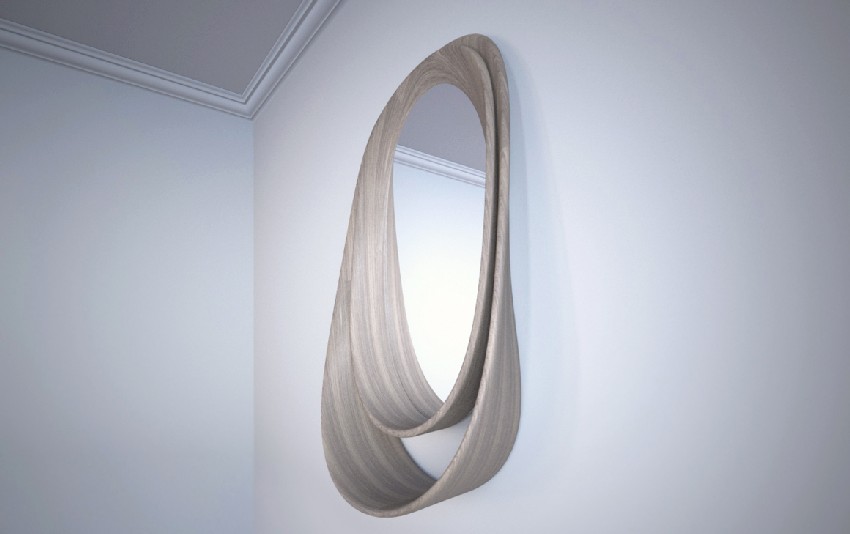
The "air" mirror is framed in wood, built from two curved bands of solid timber. Rutilo drew inspiration from the pliability of fabric and paper, giving the frame an unusual, flowing, almost weightless form. It's not just a striking piece to look at, either - the shape means the frame itself doubles as a functional shelf, giving it somewhere to rest small objects without cluttering the wall around it.
Despite how simple it looks, this piece demands real craftsmanship. Solid wood is naturally rigid, and coaxing it into a shape that reads as fluid - closer to draped cloth than cut timber - takes serious technical skill. The mirror stands 125 centimeters tall and works equally well in a private home or a public space.
Winning a Design Award Built Specifically for Mirrors
Double Loop wasn't just a striking one-off - it won first prize in the Professional category of the 2014 PORADA International Design Award, a competition run jointly by Italian furniture manufacturer Porada and Milan's POLI.design, under the patronage of ADI, Italy's Association for Industrial Design. That year's edition was built around a single, specific theme: mirrors, particularly ones that lean on wood as their primary material.
The jury wasn't small either - it included Arturo Dell'Acqua Bellavitis, dean of the School of Design at Politecnico di Milano; Roberto de Paolis, a design professor at the same institution; Bruno and Tiziano Allievi of Porada Arredi; and representatives of industry publications including Vanity Fair Italy. Alongside Rutilo's win in the professional category, the student prize went to Federica Eleonora Belli, a Politecnico di Milano student, for Weg - an oval mirror holder incorporating a container and a removable leather tray, its form inspired by an egg and by marsupial pouches.
Why Bent Solid Wood Is Genuinely Difficult
Bending solid timber into smooth, continuous curves - rather than assembling a curved shape from small cut pieces - is one of the more demanding techniques in furniture design. It's the same tradition that gave the world Michael Thonet's bentwood chairs in the 19th century, where wood is steamed and shaped under pressure until it holds a new form without breaking or splintering.
Get it wrong, and the wood cracks or springs back toward its original shape; get it right, and you end up with exactly the kind of illusion Double Loop pulls off - a rigid material that reads as soft and pliable.
A Small Object With an Outsized Role
A mirror rarely gets the same design attention as a sofa or a dining table, but it plays an outsized role in how a room actually feels - bouncing light around a space, creating the impression of depth, and often serving as the first thing anyone notices when they walk in. Double Loop is a good reminder that even the smallest, most functional objects in a room are worth genuine design attention - and it earned that recognition in one of Italy's more competitive design circles.


