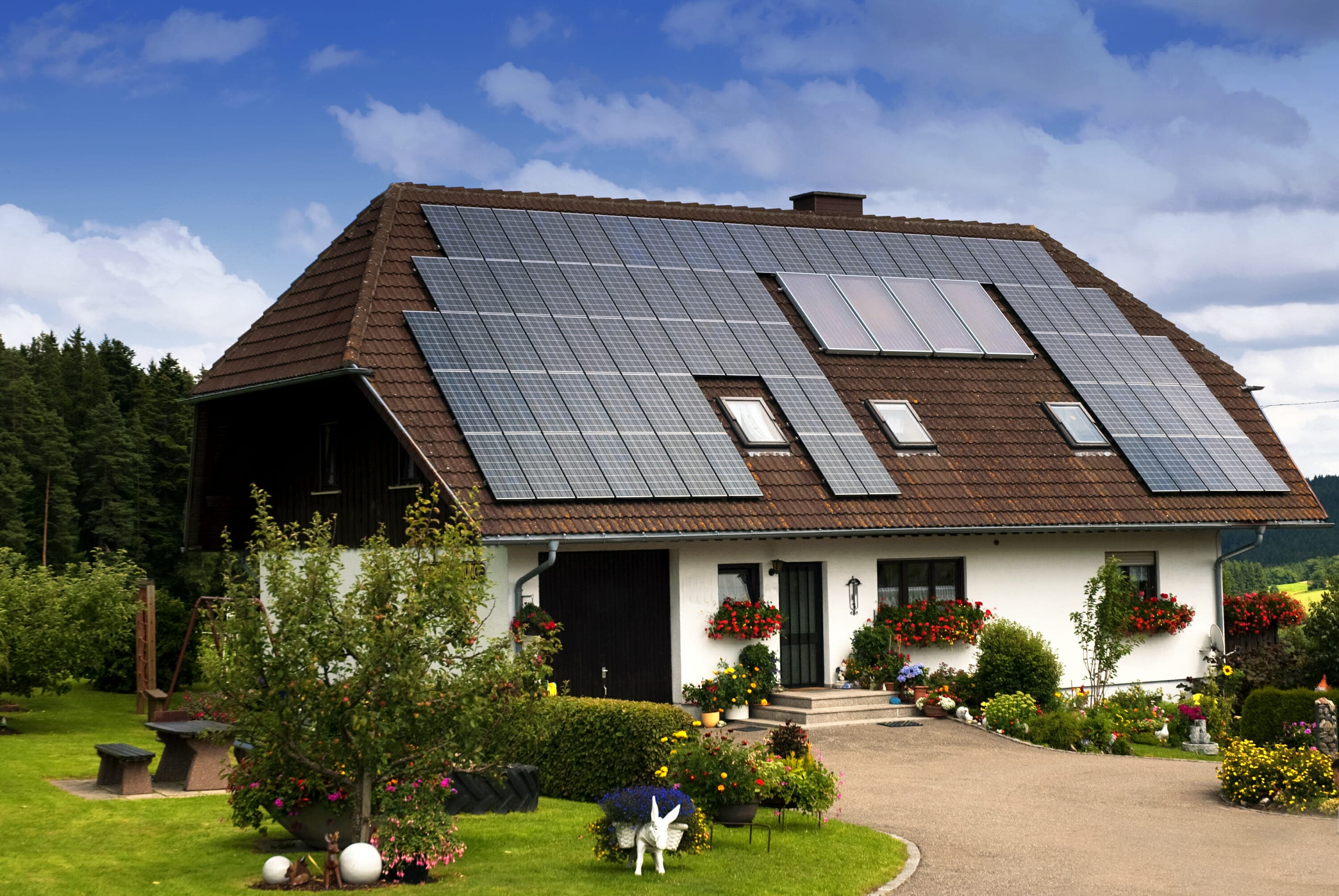
Solar panels for homes grew steadily in popularity through the 2000s. Today the technology seems ordinary, but only a couple of decades ago it felt like science fiction. The space industry paved the way: satellites have run on solar power since the late 1950s and 1960s. For a long time the technology was expensive, but science moved on, prices fell dramatically, and solar became available to ordinary households.
Solar Panels in Our Own Projects
Our cottage settlement project in the Carpathian Mountains includes solar panels as part of an off-grid-capable design, a decision that matters far more in a mountain location with a less reliable grid than in a dense city.
What Affects Performance
- Maintenance. Panels need cleaning a few times a season, because dust, pollen, and bird droppings reduce output.
- Location and shade. Shadows from trees and neighboring buildings "eat" your clean energy: the longer a panel is in full sun, the more it produces.
- Solar resource. Insolation is the amount of solar radiation per square meter over a period of time. It differs widely by region, so a solar map of your area is the starting point for sizing a system.
- Roof area. Two numbers decide it: your solar resource and your expected consumption. Look at your electricity bill. A typical home might use about 900 kWh a month, or 30 kWh a day. Divide by the number of peak sun hours per day (around 3 to 4 in Seattle on an annual average) and you get the system size: 30 / 4 ≈ 7.5 kW. A modern panel produces about 400 to 450 W and measures roughly 1.7-2 by 1.1 meters, so a 7.5 kW system needs 17 to 19 panels and about 35 to 40 m² (375 to 430 sq ft) of roof. In the 2010s, with 100 to 250 W panels, it would have taken several times as many.
- Cost. Panel prices have fallen sharply; today inverters and batteries make up a large share of the budget, so cost should be calculated for the specific house. That is also why many owners combine solar with energy efficiency rather than oversizing the system.
- Lifespan and maintenance. Manufacturers typically warrant panels for 25 to 30 years, while inverters and batteries last roughly 10 to 15 years, so the system needs ongoing maintenance and occasional reinvestment.
So the question is what matters more to you: clean energy, resilience, and long-term savings, or simply paying the monthly bill. Everyone decides for themselves. For the current numbers in our region, see our article on solar panels for private houses in Washington State.
Grid-Tied, Hybrid, or Off-Grid?
A grid-tied system is the simplest and cheapest: it feeds surplus power to the grid and draws from it at night, but it shuts down during an outage for safety. A hybrid system adds a battery and an inverter that can keep essential circuits running when the grid fails, which is why it has become the default wherever outages are common. A fully off-grid system, like the one we planned for a remote mountain site, needs larger batteries and often a backup generator, and it rewards a very efficient house, because every kilowatt-hour has to be produced and stored on site. Choosing between them starts with an honest look at how reliable your grid is and which loads truly must keep running.
Frequently Asked Questions
Do solar panels work in cloudy climates? Yes, though output varies seasonally; panels also work on cold, clear winter days, since output depends on light rather than heat.
Are solar panels worth it for a vacation or seasonal property? Often more so than for a full-time home, especially where the grid is unreliable: a property that sits empty for stretches benefits from power that doesn't depend on grid continuity.
Do solar panels affect the architecture of a house? They should be considered from the design stage, because roof orientation, pitch, and mounting affect both output and the building's appearance.
Whether solar needs to blend into a minimalist roofline or power a remote mountain property, integrating it from the start is exactly the kind of problem our architecture and custom home design services are built to solve. See also our Carpathian cottage settlement project.