Every few years Nuremberg hosts Fensterbau Frontale, one of the world's major trade fairs for windows and doors. At the 2016 edition, the German brand blaugelb caused a stir among window installers, including many from Ukraine, with its Triotherm+ installation system. By then it had already passed its tests and won praise from installers.
The system was developed by the German Meesenburg group, which owns the blaugelb brand, and it is promoted in Ukraine by the company's local office. It differs fundamentally from earlier approaches to insulating around windows.
Why It Matters
Insulating facades matters for every kind of building, from cottages and new apartment blocks to houses built in the 1980s. Usually it means comprehensive facade work combined with replacing windows and doors. Traditionally the window sat in the opening of the structural wall; the innovation is to build a frame of moisture-resistant insulating profiles around the opening and mount the window within the insulation layer. That moves the frame into the warm zone and removes the thermal bridge at the junction, making installation faster and the result more energy-efficient.
Key Features of blaugelb Triotherm+
- A new connection system without dovetails, making it easy to transport and assemble different profiles on site.
- Profiles made of dense polystyrene with low-flammability fire classes (B1 and E).
- Durable, stable profiles that are easy to install and work with any facade system.
- Designed specifically for window installation at the level of the thermal insulation.
- Fully recyclable material.
- Sealing with Power Fix, a one-component, permanently elastic polymer used for movement and installation joints.
- Tested in Germany, including for burglary resistance, and certified.
- FK-T30 frame screws in carbon steel that anchor the profile even into brick.
Triotherm+ works with a variety of joint insulation methods - polyurethane foam, vapor and waterproofing tapes, or pre-compressed sealing tapes. The one rule is to follow the requirements for sealing installation joints. To get a convincing result, choose the energy-efficiency measures that fit the specific project, and the system keeps installation costs low.
Choosing Profile Thickness
The profiles come in several thicknesses, and the right one depends on the thickness of the exterior insulation and the energy target of the building. Thicker profiles insulate better, so they suit deep insulation layers and high-performance homes, while thinner ones fit renovation projects with modest insulation. The profile should end flush with the insulation so the facade finish runs continuously over the joint.
When It Makes Sense
Mounting windows in the insulation layer pays off most on new houses and deep energy retrofits with exterior insulation of 100 mm or more, on large windows where the perimeter is long, and anywhere condensation or mold at the reveals has been a problem. On a wall without exterior insulation, the benefit is small, and a conventional installation with good sealing tapes is usually enough.
Window Installation in the Pacific Northwest
In Seattle's wet climate, the bigger risk at windows is water rather than cold. Placing windows in line with exterior insulation and a rainscreen, with sloped sill pans, proper flashing, and a continuous air barrier, protects both energy performance and the wall itself. The principle behind Triotherm+ - keeping the frame in the insulation layer - fits well with how high-performance and Passive House-style homes are built here.
Frequently Asked Questions
How much does Triotherm actually improve insulation performance? The system's U-value ranges from roughly 0.73 W/m²K at 50mm thickness down to about 0.48 W/m²K at 74mm - meaning thermal performance improves substantially as the profile gets thicker, which is why thickness selection should be matched to the specific climate and energy targets of the project.
Does Triotherm work with any window material? Yes - the system is compatible with PVC, aluminum, wood, and wood-aluminum window constructions, which is part of why it has become a standard specification across different building types rather than being limited to one window system.
Why does window position within the wall matter so much? Positioning the window flush with the insulation layer, rather than recessed behind it, eliminates a common thermal bridge - a point where heat escapes disproportionately compared to the surrounding wall - which is precisely the building-physics problem Triotherm's outboard mounting approach was designed to solve.
Getting window placement and insulation detailing right the first time - rather than discovering thermal bridging problems after construction - is exactly the kind of coordination our architecture and material selection services are built to handle.
Good insulation is the foundation of energy efficiency, but not the whole story. For how it fits with architecture, windows, and engineering, see our piece on a modern energy-efficient house.
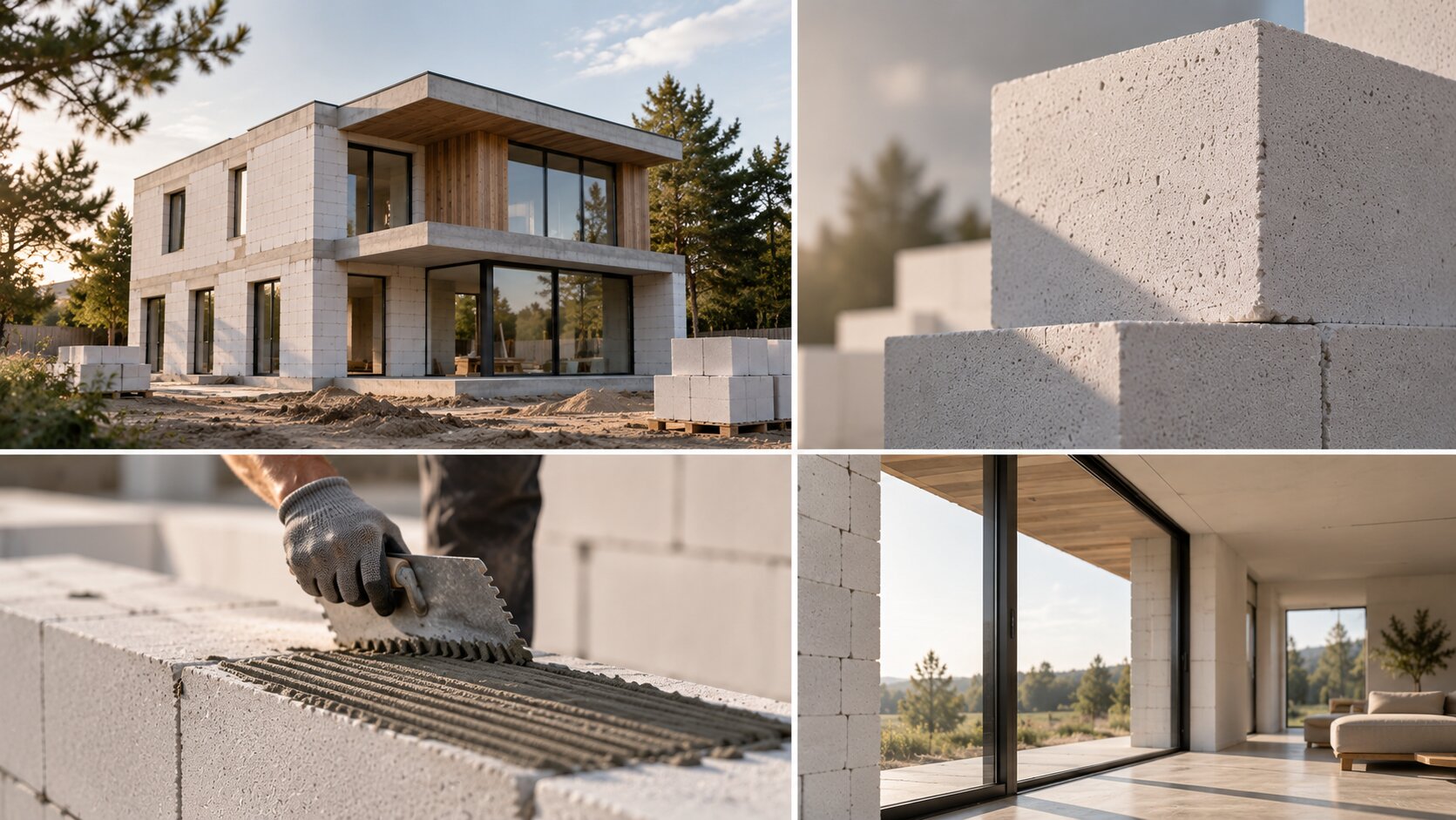
The Triotherm system is often applied specifically on aerated concrete walls - more on this in our piece on a gas block and foam block house.