
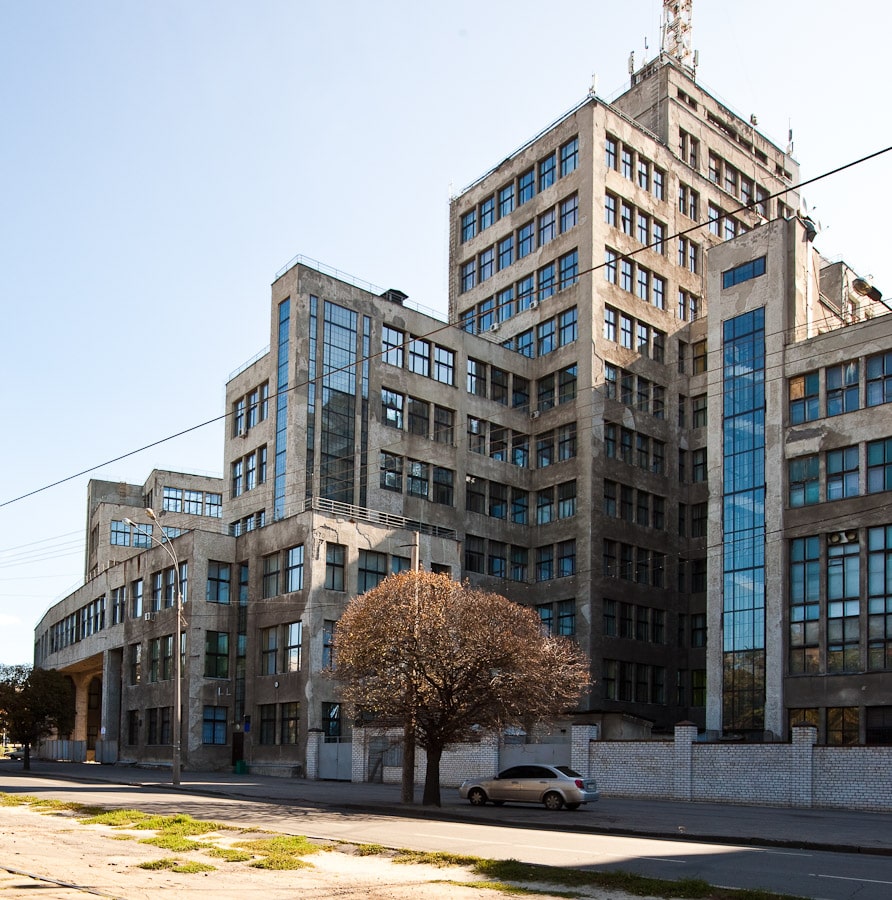
Constructivism is one of the most distinctive and recognizable architectural styles of the former Soviet Union. It emerged in the 1920s out of avant-garde art and became one of the earliest versions of modernism: architecture in which a building's form comes from its structure and purpose rather than from ornament. Ukraine holds some of its most important landmarks, above all Derzhprom in Kharkiv (1925-1928), on Ukraine's tentative list for UNESCO World Heritage and damaged several times by Russian strikes since 2022.
Where Constructivism Came From
It is often said that Constructivism grew out of Art Nouveau, but it was really a reaction against it. Its roots lie in the avant-garde art of the 1910s: Vladimir Tatlin's counter-reliefs, Kazimir Malevich's Suprematism, and the work of Alexander Rodchenko. The artists began calling themselves Constructivists in 1921, believing that art should not decorate life but construct a new one.
The new aesthetic had engineering precursors in which structure itself became the image: London's Crystal Palace (1851), the Eiffel Tower (1889), and Vladimir Shukhov's hyperboloid lattice towers, including the Shabolovka radio tower in Moscow (1920-1922). Concrete, steel, and glass gave architects a freedom that load-bearing brick walls never allowed.
In 1925, Moisei Ginzburg and the brothers Leonid, Viktor, and Alexander Vesnin founded the Association of Contemporary Architects (OSA), the main school of architectural Constructivism. Ginzburg formulated the "functional method": design begins with an analysis of the processes that will take place in a building, and form follows from that analysis.
A New Way to Live and Build
Constructivism was a social project as much as a style. Its architects believed new architecture should create a new way of life: communal dining halls, laundries, kindergartens, and clubs would free people from domestic routine. That gave rise to new building types: workers' clubs, factory kitchens, commune houses, and palaces of labor.
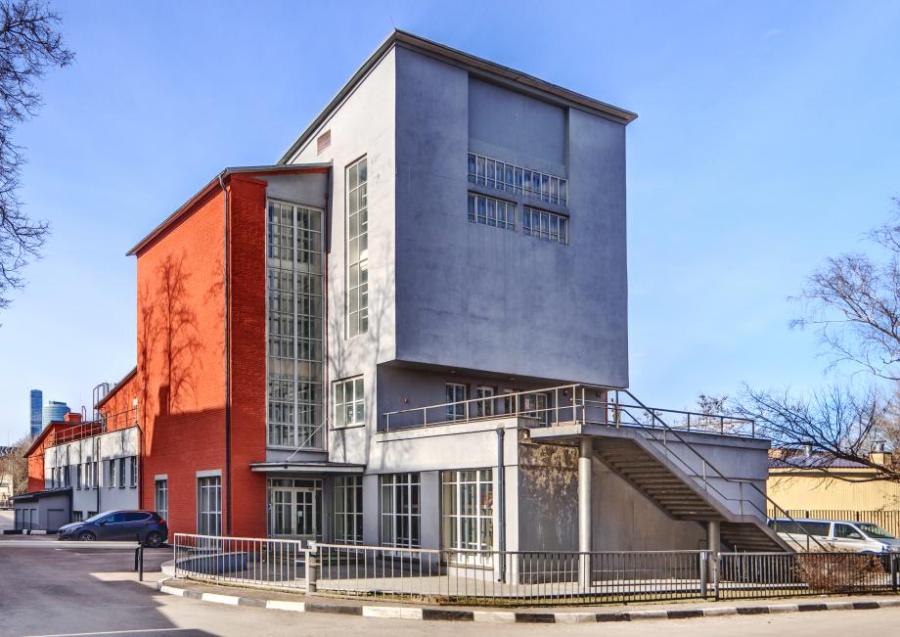
Simple forms were seen as democratic. The core idea was no unnecessary ornament, only structure honestly doing its job. Expression came from volumes, ribbon windows, cantilevers, stair towers, and the contrast between glass and solid wall. Working apart from OSA, Konstantin Melnikov designed the Rusakov Workers' Club and his own cylindrical house in Moscow, while the Rationalists led by Nikolai Ladovsky studied how form shapes perception.
Paper Architecture and Real Buildings
Many avant-garde projects never left the drawing board because they were ahead of the technology and economy of their time. The best known are Tatlin's Tower (the Monument to the Third International, 1919-1920), a 400-meter spiral structure, and El Lissitzky's "horizontal skyscrapers" (1923-1925), meant to hover over Moscow's squares. Ivan Leonidov's Lenin Institute project (1927) still looks like something from the future.
But many Constructivist buildings were built and still stand across the former Soviet Union: factories, clubs, housing blocks, schools, and administrative complexes. These projects stayed within strict economy and utility, yet they shaped entire districts.
Defining Features
- Form from function. The volume of a building expresses what happens inside: stairs, halls, and housing blocks read from the outside.
- Composition of simple volumes. Boxes, cylinders, and cantilevers combine into a whole, and splitting the building into parts actually strengthens its unity.
- New materials. Reinforced-concrete frames, glass, and steel made possible ribbon windows, fully glazed stair towers, and flat roof terraces.
- No ornament. Expression comes from proportion, the rhythm of windows, and the contrast of glass and solid planes.
- Scale. The best-known buildings were enormous for their time and set the scale for new city centers.
- Color. Facades were mostly white, gray, or light beige, with red brick as an occasional exception, while interiors often had carefully planned color schemes.
Commune Houses
The commune house is a vivid example of the era's ideas, with daily life shared by all residents. Ivan Nikolaev's student commune house in Moscow (1929-1931) was designed for about 2,000 students: tiny cabins used only for sleeping, with study, sport, meals, and leisure in shared spaces. Whether people could live like that for long is debatable, and the building was later remodeled.
Another famous example is the Narkomfin Building by Moisei Ginzburg and Ignaty Milinis (1928-1930). It combined a shared dining hall, library, and laundry with several apartment types, including two-level units. The building stands on reinforced-concrete columns, with ribbon windows along the entire facade and a flat roof terrace, showing a clear influence of Le Corbusier. It was restored in 2017-2020.
Constructivism's Legacy, All the Way to Seattle
Constructivist ideas never really disappeared from architecture. Rem Koolhaas, founder of OMA, has long acknowledged his debt to the Russian avant-garde and especially to Ivan Leonidov, and Seattle has one of the clearest heirs of that thinking: OMA's Seattle Central Library (2004), whose stacked, shifted volumes are each shaped by what happens inside them - a direct descendant of the functional method. We compared it with another landmark library in our article on Oslo's Deichman library. In a private home, the same principles - clear volumes, cantilevers, ribbon windows, and flat roof decks - work beautifully as long as the details handle the Northwest's rain.
The End and Return of the Style
Constructivism dominated for about a decade. In the early 1930s, after the Palace of Soviets competition and the dissolution of independent artistic groups in 1932, it was replaced by Soviet Neoclassicism, with lavish ornament and a very different ideology.
Decades later, in the 1960s and 1970s, Soviet modernism brought simplicity back. Constructivism's European sibling was the Bauhaus, with which Soviet architects exchanged ideas actively.
Frequently Asked Questions
How is Constructivism different from Functionalism? Both derive form from purpose, but Constructivism valued the expressive power of structure as an artistic image, while Functionalism aimed for maximum rationality.
What is the most famous Constructivist building? Among the best known are Derzhprom in Kharkiv (1925-1928), the Narkomfin Building, and the Rusakov Workers' Club in Moscow.
Can a modern house be designed in a Constructivist spirit? Yes: clear volumes, cantilevers, ribbon windows, and flat roof terraces work very well in a contemporary home, as long as insulation and weather protection are designed carefully.


