
New York is the city of dreams for millions of people around the world. Its energy is magnetic, the kind that pushes you toward something new. Picture it, and Broadway and Times Square usually come to mind first: the crowd, everyone rushing somewhere, someone grabbing coffee to go, someone hailing a yellow cab, someone closing a deal on the phone mid-stride.
And yet, for all its familiar image, the city still has room to surprise. New York changes as fast as any major city does - change is simply part of what it means to keep developing. One of the clearest examples of that transformation is Hudson Yards on Manhattan's Far West Side, a new district designed by some of the world's best-known architects and billed as the largest private real estate development in American history.
Its centerpiece, Thomas Heatherwick's "Vessel," has become a new and genuinely divisive symbol of New York. Some call it brilliant, some think its significance is overstated, and some simply dislike it. Either way, it's impossible to ignore.
The Numbers
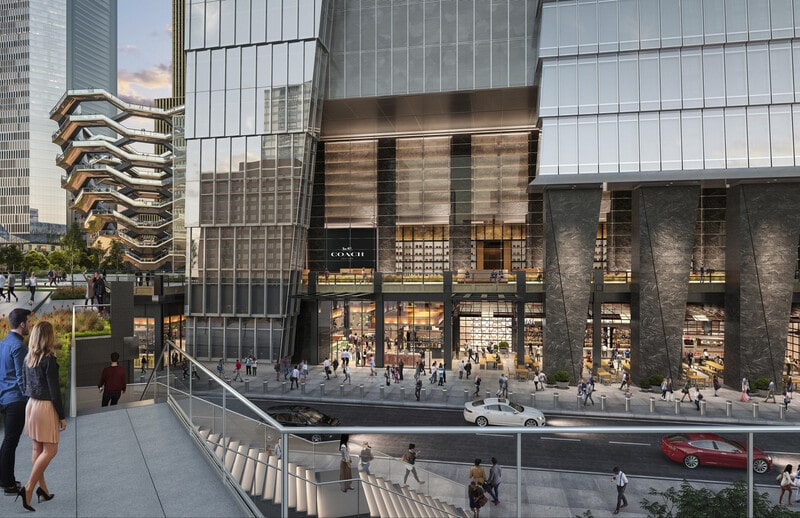
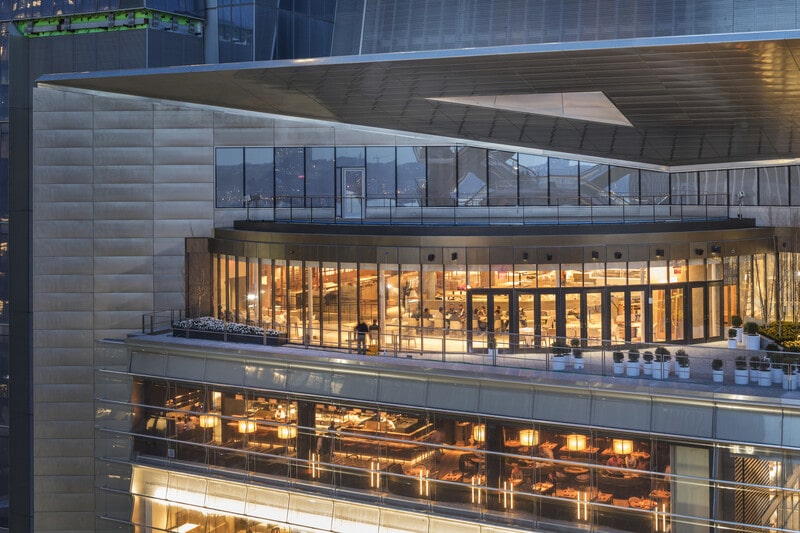
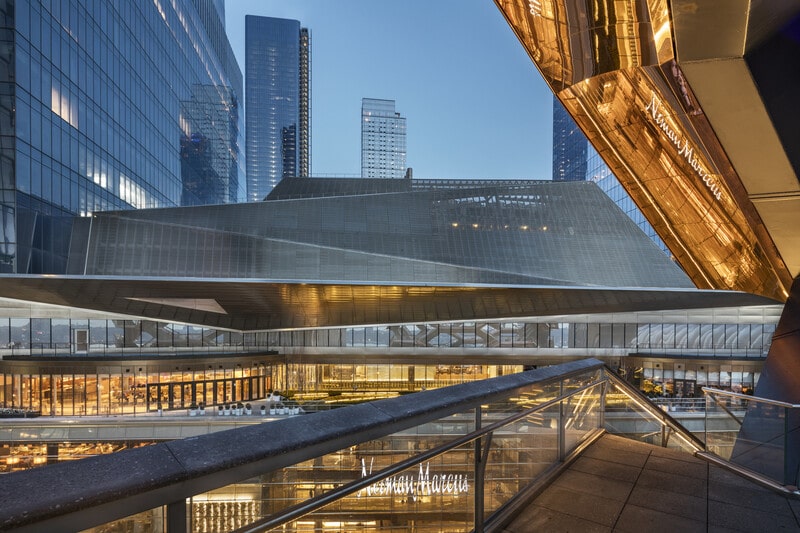
Hudson Yards was developed by Related Companies and Oxford Properties, with a master plan by Kohn Pedersen Fox. Across its two phases, it is planned to hold about 18 million square feet (roughly 1.7 million square meters) of offices, apartments, shops, and public space on 28 acres. The first, eastern phase includes office towers such as 10, 30, and 35 Hudson Yards, the seven-level Shops and Restaurants at Hudson Yards with more than 100 stores and places to eat, the Equinox Hotel, the arts center The Shed, and a public square and gardens. The eastern half opened to the public on March 15, 2019, one of the most talked-about architectural openings of the decade.
What makes the site unusual is what lies beneath it. Hudson Yards sits on a platform built over the West Side Yard, where Long Island Rail Road trains are still stored and serviced. The platform is supported by around 300 caissons drilled down between the tracks, so the trains could keep running throughout construction, which began in December 2012. Developers have estimated the total cost of the project at about $25 billion.
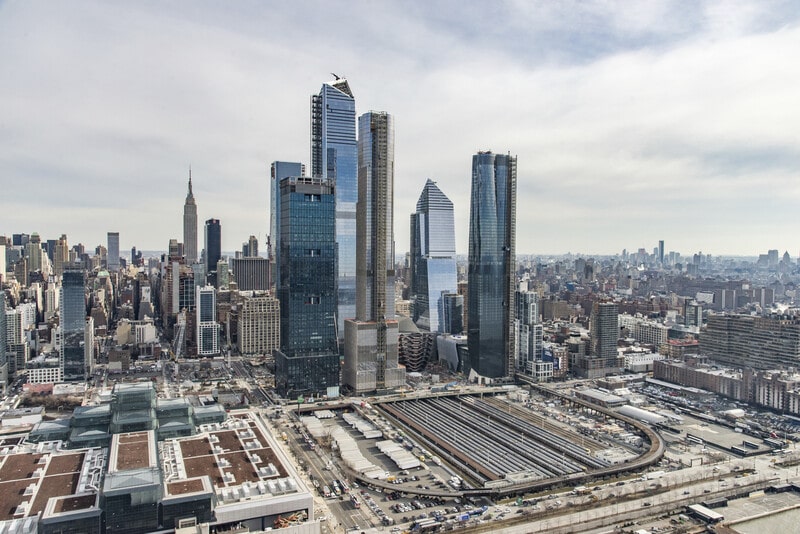
The district runs roughly between 10th and 12th Avenues and West 30th to 34th Streets, right where the High Line elevated park ends. It's easy to reach: the 7 subway line was extended to a new 34th Street-Hudson Yards station, opened in September 2015, and the area is close to Penn Station, the Lincoln Tunnel, and Hudson River ferries. In March 2020, Edge opened at 30 Hudson Yards - an outdoor observation deck about 1,100 feet (335 meters) up, marketed as the highest in the Western Hemisphere.
The developers projected that around 125,000 people a day would eventually work in, live in, or visit the district. Beyond its own restaurants and attractions, the surrounding neighborhood offers galleries, bars, and fashion events, and the area keeps growing.
One more building deserves a mention: The Shed, a cultural center by Diller Scofidio + Renfro with Rockwell Group that opened in April 2019. Its outer shell sits on rails and can roll out over the adjacent plaza, roughly doubling the building's footprint for large performances and exhibitions, then roll back to return the plaza to the public. It's a rare example of a building that physically changes shape depending on what the city needs from it that day.
The Vessel
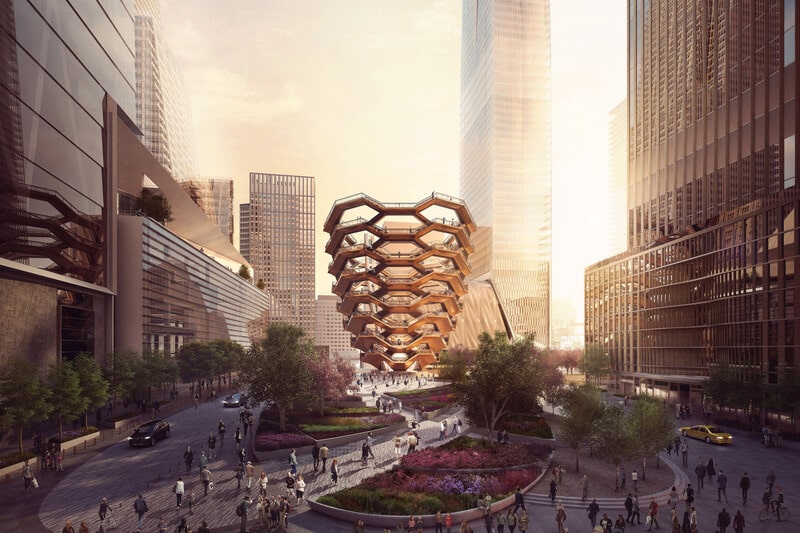
Every building in the district has its own role, but the Vessel is the heart of the composition. Rising about 150 feet (46 meters), it is a honeycomb of 154 interconnected flights of stairs, nearly 2,500 steps, and 80 landings, with an elevator for those who prefer not to climb. Its steel structure is clad in polished, copper-toned steel that catches the light and gives the whole public square a focal point.
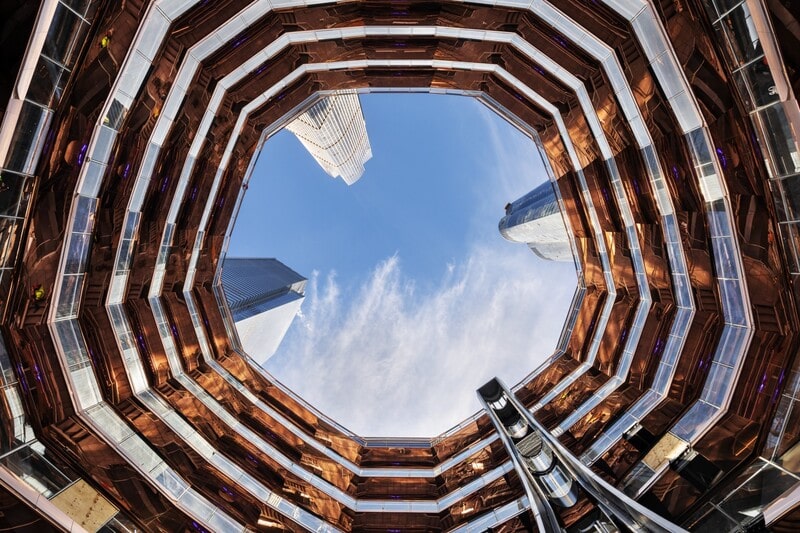
Thomas Heatherwick and his studio kept the design under wraps during development. The structure was fabricated in Italy, shipped across the Atlantic in pieces, and assembled on site, and until it went up, few people knew what the finished piece would look like.
New Yorkers' reactions have been mixed from the start. Some see a beehive or a shawarma spit; others compare it to an inverted Eiffel Tower. Its price tag, reported at around $150 million and later higher, drew just as much attention. Soon after opening, the Vessel's original terms of use, which claimed rights to visitors' photos, caused an outcry and were revised. The structure was closed in 2021 after a series of tragic deaths and reopened in October 2024 with new safety barriers on its upper levels.
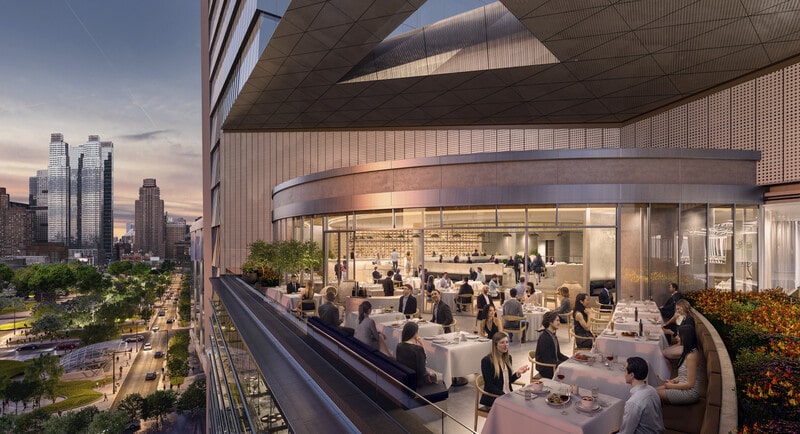
The team behind the Vessel knew it would be divisive. Their aim was a place to walk, meet, and take in the city, and they were clear that how it is used would ultimately be up to New Yorkers. Landscape architect Thomas Woltz of Nelson Byrd Woltz led the design of the public square and gardens around it, spending a long time making sure the plantings could thrive on a platform over a working rail yard. It took time, but the result holds up.
The Cost - and the Criticism
Hudson Yards has become one of New York's biggest attractions and one of its biggest arguments. Critics point to the public money behind it: researchers at The New School estimated that tax breaks and public investment, including the subway extension and park infrastructure, added up to about $5.6 billion. Others question how "public" the space really is, since much of it is privately owned and managed, and describe the district as a playground for the wealthy rather than a neighborhood.
Even so, Hudson Yards brought together an extraordinary roster of designers: Heatherwick Studio, Kohn Pedersen Fox, SOM, Diller Scofidio + Renfro with Rockwell Group, Elkus Manfredi, and Nelson Byrd Woltz, each contributing a piece of an unmistakably contemporary skyline. The eastern half is complete, while the western half over the rest of the rail yard is planned as a later phase.
What Seattle Can Learn From It
Building over working rail lines is not just a New York idea. In Seattle, the long-discussed proposal to "lid" Interstate 5 through downtown would similarly create new land and public space over transportation infrastructure, and the city has studied its feasibility. Hudson Yards shows both sides of such projects: they can stitch neighborhoods together and add housing, offices, and parks where there was only a trench, but they are enormously expensive and need careful attention to who the new public spaces are really for.
Frequently Asked Questions
Who designed Hudson Yards? The master plan is by Kohn Pedersen Fox; the Vessel is by Heatherwick Studio; other buildings are by SOM and Diller Scofidio + Renfro with Rockwell Group, and the landscape by Nelson Byrd Woltz. Related Companies and Oxford Properties are the developers.
Can you climb the Vessel? Yes. It reopened in October 2024 with new safety barriers; tickets are required.
Why is Hudson Yards built on a platform? Because it sits over a working rail yard; the platform lets trains keep running underneath.


